
Home › Knights News › Rugby 101
Rugby 101Rugby discipline: how to stop giving away penalties
Most penalties are not bad luck or bad refereeing. They are habits: drifting offside, diving off your feet, a late shot, a word too many. Here is how a defense-first team builds the habits that keep the scoreboard quiet.
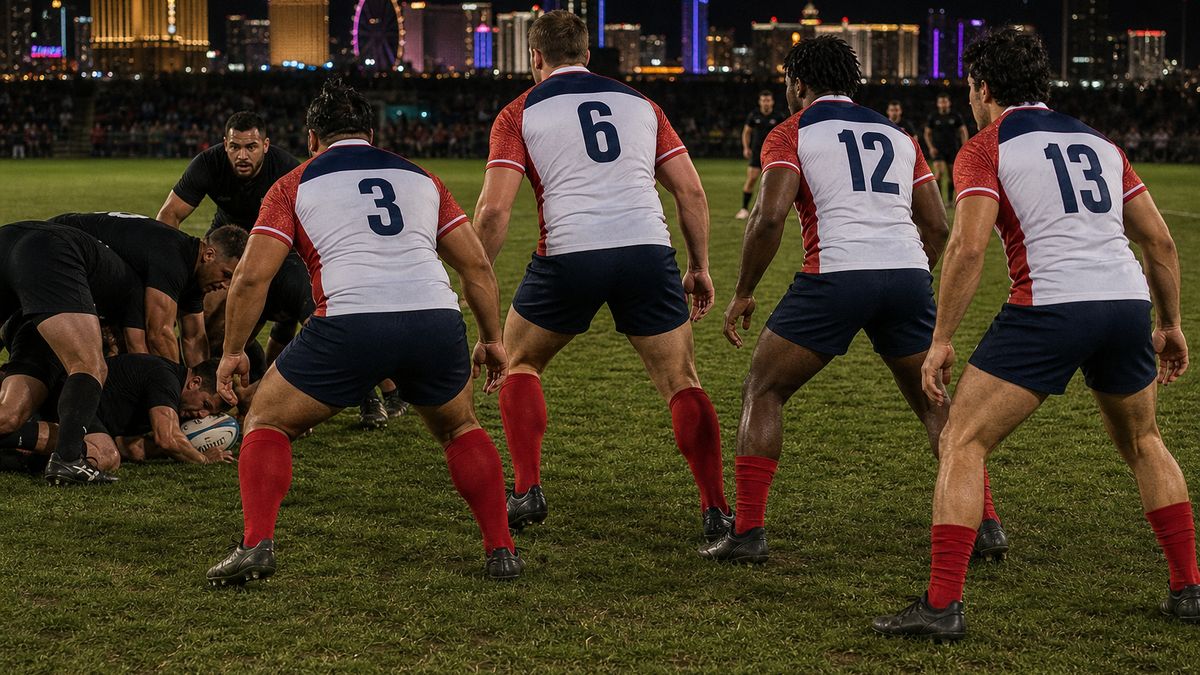
Key facts at a glance
- Offside in open play: a player is offside if they are "in front of a team-mate who is carrying the ball or who last played it" (World Rugby Law 10.1).
- Ruck offside line: runs "through the hindmost point of any ruck participant" (Law 15.4); you must join from behind it or retire behind it immediately (Laws 15.5 and 15.8).
- Penalties per test: Rugby World Cup 2019 averaged 17 penalties and free-kicks per match, down from 22 in 2015 (World Rugby statistical report).
- Repeat offences: "A team must not repeatedly commit the same offence" (Law 9.8); after a general warning, the next offender can be shown a yellow card (Law 9.10).
- Yellow card: 10 minutes in fifteens (Law 9.29), two minutes in World Rugby's 10s variations; a second yellow means a red.
- Talking back: "Players must respect the authority of the referee. They must not dispute the referee's decisions." (Law 9.28). Sanction: penalty.
The Knights have spent five guides building a defense: rugby defense systems, how to tackle in rugby safely, rugby fitness for defenders, breakdown defense and defending in tens rugby. None of it matters if the referee keeps blowing his whistle at you. A defense that makes ten great tackles and then concedes a penalty from 30 meters out has done the attack's work for them.
This guide is about rugby discipline in the practical sense: the specific penalties defenders give away, what the World Rugby laws actually say, and the habits and drills that stop them. We covered the breakdown offences in detail in our jackal and counter-ruck guide, so here the focus is on offside, the tackle, cards and talking to the referee. If you are brand new to the laws, read Downtown Rugby's rugby rules for beginners first.
Why does discipline matter so much in rugby?
Because a penalty is the cheapest way to lose ground and points. The non-offending team can kick at goal, kick to touch and keep the throw, tap and go, or take a scrum. In the modern game, a kick to the corner followed by a lineout drive is one of the most reliable ways to score a try, so a penalty conceded in your own half often costs far more than three points.
Elite teams have got better at this. World Rugby's statistical report on Rugby World Cup 2019 shows an average of 17 penalties and free-kicks per match, against 22 in 2015, 21 in 2011 and 19 in 2007. The same report found one penalty or free-kick for every 27 breakdowns, one for every four scrums and one for every 55 lineouts. The breakdown happens so often that, even at that rate, it produces a big share of the whistles.
At club level the numbers can be much uglier. When The Irish Times analyzed a Pro14 game between Munster and Connacht (3 September 2020), it counted 37 penalties "officially", and found that one facet of the game, the breakdown, accounted for 57 per cent of them, with all three yellow cards for breakdown offences. Twenty-two penalties had been awarded by half-time. That is a game where neither team could build any rhythm, and it is what an undisciplined match looks like.
Honor is the first word in the Knights Code, and in rugby honor has a very practical meaning: you play by the laws even when you are tired, losing and sure nobody is watching. A penalty is not just three points. It is ten meters, the ball and the momentum, handed over for free. A defense-first team treats every unforced penalty as a missed tackle.
What are the most common penalties defenders give away?
Every referee and competition is different, but the same handful of offences come up again and again for defending teams. This table gathers them in one place, with the law and the habit that fixes each one.
| Penalty | What it looks like | World Rugby law | The habit that fixes it |
|---|---|---|---|
| Offside at the ruck | Defender standing in front of the last feet, or joining from the side | 15.4, 15.5, 15.8 | Find the hindmost foot, then get behind it before looking up |
| Offside in open play | Defender in front of a team-mate who last played the ball and then tackling or interfering | 10.1, 10.4 | Retreat behind the ball, then reload |
| 10-meter offside after a kick | Chaser in front of the kicker not retiring from where the ball lands | 10.4c, 10.8 | Chasers start behind the kicker; everyone else retreats |
| Not releasing / not rolling away | Tackler holding on or lying on the ball side | 14.5 | Release, roll away, get back to your feet, then compete |
| Off feet / hands in the ruck | Diving over the ball or picking it up once a ruck has formed | 15.11, 15.12 | Support your body weight; if the ruck forms, hands off |
| High or dangerous tackle | Head contact, a swinging arm or a hip-drop tackle | 9.13 | Tackle low, head to the side, never leave your feet |
| Offside at the maul | Defender loitering beside the maul or joining from in front | 16.4, 16.5 | Join from behind the hindmost foot or retire |
| Not retreating 10 meters | Standing on the mark or slowing a quick tap | 20.12 | Turn your back, sprint ten, then turn and defend |
| Dissent | Arguing a decision, gestures, chirping | 9.28 | Only the captain speaks, briefly and calmly |
Law numbers from World Rugby's Laws of the Game on World Rugby Passport (accessed November 2026). Your competition may use variations; check before the season.
How does offside work in open play?
This is the one that catches the most new players. World Rugby Law 10.1 says: "A player is offside in open play if that player is in front of a team-mate who is carrying the ball or who last played it." When the last action is a kick, "the foot kicking the ball determines the offside line." Law 10.2 adds that a player can be offside anywhere on the field.
Being offside is not an offence on its own. The law says an offside player must not play the ball, tackle the ball-carrier, prevent the opposition from playing as they wish, or loiter in an offside position. The penalty comes when an offside player interferes, moves towards the ball or fails to retire (Law 10.4).
How do you get back onside? Under Law 10.6 an offside player is put onside when they move behind the team-mate who last played the ball, or behind a team-mate who is onside. Under Law 10.7 they can also be put onside when an onside team-mate runs past them, when an opponent kicks the ball or intentionally touches it without gaining possession, or when the ball goes into touch.
There is also accidental offside (Law 10.5): if a player cannot avoid being touched by the ball or by a team-mate carrying it, the sanction is a scrum, not a penalty.
The 10-meter law: the kick-chase trap
The most expensive open-play offside usually follows a kick. Under Law 10.4c, a player in front of a kicking team-mate must "retire immediately behind an onside team-mate or an imaginary line across the field 10 metres on that player's side from where the ball is caught or lands." It does not apply when the kick is charged down. Law 10.8 makes it stricter: a player offside under 10.4c "cannot be put onside by any action of an opponent, apart from a charge down."
In plain words: if you are in front of your kicker, you are out of the game until your kicker or an onside team-mate runs past you, and you must head back out of that ten-meter zone straight away. Rugby365's long-running law column described the zone as stretching the whole width of the field. Players who stand still and "wait to be put onside" by the catcher running at them are exactly the ones referees penalize.
For more on the kicking side of this, the Vegas Kings' guide to the rugby kicking game: box kicks, grubbers and the last-tackle kick explains how teams set up their kick chase so the chasers start onside.
Where is the offside line at a ruck and a maul?
Once a ruck forms, the offside line moves. Law 15.4: "Each team has an offside line that runs parallel to the try line through the hindmost point of any ruck participant." Law 15.5 says an arriving player "must be on their feet and join from behind their offside line", and Law 15.8 says players "must join the ruck or retire behind their offside line immediately." Both are penalties.
The maul works the same way, but the line runs through the hindmost foot: under Law 16.4 each team's line runs "through the maul participants' hindmost foot that is nearest to that team's try line," and Law 16.5 requires players to join from an onside position or retire immediately.
Two details trip up defenders. First, Law 10.9: a player who is offside at a ruck, maul, scrum or lineout "remains offside, even after the ruck, maul, scrum or lineout has ended." You cannot just wait for the scrum-half to pass and then charge. Under Law 10.10 you are put onside only if you immediately retire behind the offside line, an opponent carries the ball five meters, or an opponent kicks it. Second, when the referee awards a penalty for offside at a phase of play, Law 20.1 puts the mark at the offending team's offside line, so it costs real ground.
For the attacking side of the ruck, the Vegas Blackjacks' guide rugby rucking explained shows how attackers build a ruck, which helps defenders read where its last feet will be.

How do you avoid penalties in the tackle?
The tackle area produces two kinds of penalties: the tackle itself, and what happens in the second after it.
The tackle. Law 9.13 says a player "must not tackle an opponent early, late or dangerously," and dangerous tackling includes a tackle "which leads to head contact." World Rugby added the hip-drop tackle to that dangerous-play law from 1 November 2026. For community rugby, World Rugby's Council approved a lower tackle height into full law on 17 June 2026, for seasons starting after 1 July 2026, with competitions choosing the base of the sternum or the waist; USA Rugby has used a sternum variation since 1 September 2024. Our safe tackling guide covers technique in detail: bend at the waist, head to the side, wrap the arms, drive with the legs.
After the tackle. Under Law 14.5, the tackler must release the ball-carrier, move away or get up, and be back on their feet before playing the ball. The tackled player must make the ball available immediately (Law 14.7). Once a ruck forms, no one may handle the ball unless they had their hands on it before the ruck formed and stayed on their feet (Law 15.11), and players must stay on their feet (Law 15.12). World Rugby's breakdown guidance also says a jackler "must support their body weight throughout."
The fix is a simple order of operations, trained until it is automatic: tackle, release, roll, rise, then decide. If the tackle is dominant, the next defender can compete. If it is passive, the tackler rolls away toward the touchline and returns to the line. The breakdown defense guide goes through those decisions.
Safety note: tackling and competing at the breakdown are contact skills with real injury risk. Learn and progress them under a qualified coach, build up gradually, and follow your union's current tackle-height laws.
Most tackle-area penalties happen because a player tries to do two jobs at once: finish the tackle and steal the ball. Do them in order. Release, get back on your feet, then compete. Half a second of patience beats a penalty, and the defender who is always on his feet is the one the referee trusts.
What happens when a team keeps giving away penalties?
Referees give teams a little room, but not much. Law 9.8 says "A team must not repeatedly commit the same offence," and Law 9.9 says "A player must not repeatedly infringe the laws." When different players from the same team keep making the same mistake, Law 9.10 lets the referee give the team a general caution and then show a yellow card to the next offender.
Cards change games quickly:
- Yellow card. Under Law 9.29 the player is "suspended for 10 minutes". A second yellow-card offence means the player "must be sent off." In World Rugby's 10s variations, used for formats like the APR Games, a yellow card lasts two minutes; the Kings explain the format in rugby tens explained.
- Red card. Under Law 9.30 the player takes no further part, and in community rugby "A player sent off may not be replaced."
- The 20-minute red card (elite rugby). World Rugby's Council moved the 20-minute red card into a global law trial on 21 May 2025 for elite competitions: for red cards that are not deliberate, the team can bring on a replacement after 20 minutes, while "intentional and highly dangerous" actions still mean a full red. The Council approved it into full law at its 17 June 2026 meeting, effective for competitions starting after 1 July 2026. Check your own competition: most community games still use the standard red card.
Some penalties also move forward. If the offending team commits another offence before the penalty is taken, Law 20.1 advances the mark 10 meters. And under Law 20.12 the defending team "must immediately retreat 10 metres"; if they do not, the sanction is a second penalty 10 meters in front of the original mark. That is how one penalty on halfway turns into a lineout in your 22.
How should players talk to the referee?
Through the captain, briefly, and with respect. Law 9.28 is clear: "Players must respect the authority of the referee. They must not dispute the referee's decisions." The sanction is a penalty, and repeated dissent can lead to a card.
World Rugby's guidance for referees points the same way. Its officiating material on "the voice" says match officials "should not engage in extended dialogue with players other than the captain, and even then only on specific issues," and that referees should identify players by team name or color plus number. So the most useful thing a defender can do is listen: when the referee says "hands off" or "roll away", do it at once.
Practical rules for a disciplined team:
- One voice. The captain asks questions. Everyone else gets back onside.
- Ask, don't argue. "Sir, what do you need from us at the ruck?" gets an answer. "That's never a penalty!" gets ten more meters.
- Pick the moment. Stoppages, not while the penalty is being taken.
- Pass it on. The captain tells the team what the referee wants: "He's tight on hands, ball side only."
- No chirping. Law 9.27 says a player "must not do anything that is against the spirit of good sportsmanship."
Teams can also show respect off the field. Some clubs send a short thank-you to referees, coaches and volunteers after a tournament; Giftabiz, one of the APR sponsors, works with gifts and personal video messages for businesses, a neat fit for sponsors or partners who want to say thanks after a season.
Which drills build discipline?
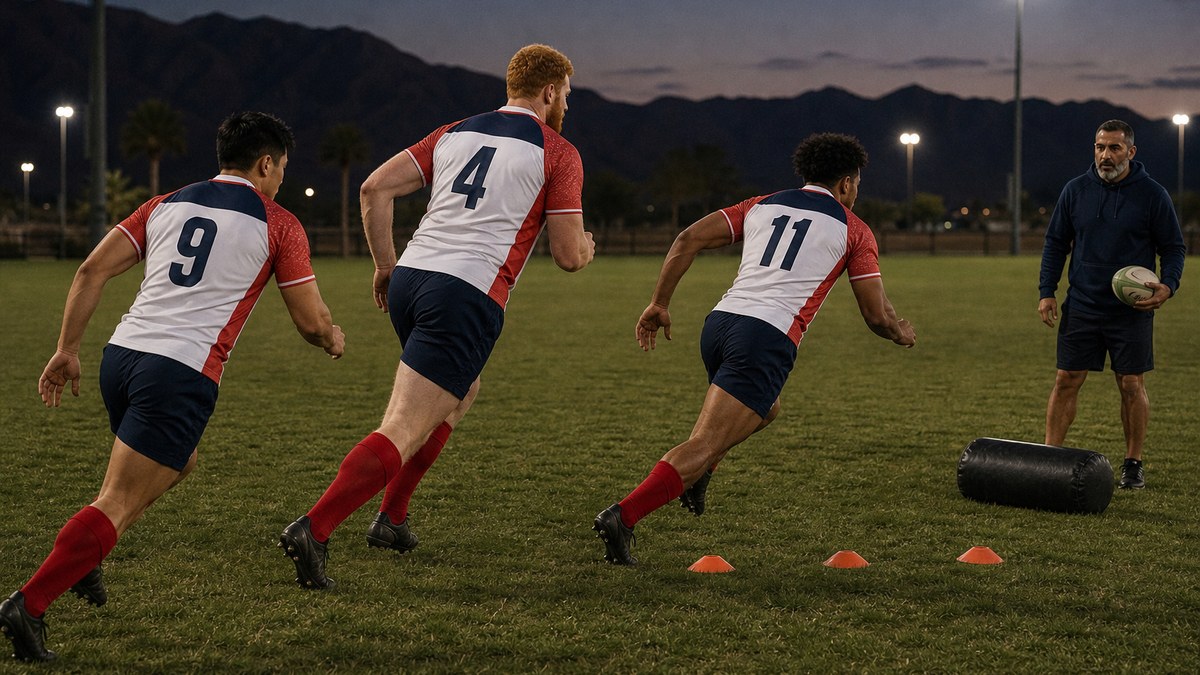
Discipline is a skill, and like any skill it breaks down under fatigue. Our fitness for defenders guide showed how many repeat efforts players make in a match; the tired fourth effort is when players lie on the wrong side or forget to retreat. These drills put the habits under pressure. Run them under a qualified coach and keep contact levels appropriate for your group.
- Retreat and reload. Set a line of cones as the "last feet" of an imaginary ruck. On the whistle, defenders sprint around the cones to get onside before turning to face the attack. Add a coach who shouts a new ruck position every few seconds.
- Tackle, roll, rise. Using tackle bags or tackle shields, the tackler makes a controlled low tackle on the bag, releases, rolls away to a cone and gets back on their feet before a team-mate is allowed to compete. Penalize any hands on the ball before the tackler is up.
- Kick-chase onside game. One player kicks; teammates who start in front of the kicker must retreat behind a coach's 10-meter line before they can chase. Any player who plays the ball from the zone gives up a point.
- Referee in the room. Have a coach or club referee officiate a controlled game with strict calls and a running penalty count on a whiteboard. Teams lose a point for every penalty and gain one for every three-minute block with none.
- Captain's call. In conditioned games, only the captain may speak to the "referee". Anyone else who argues hands the other team a free possession.
- Video review. After a match, cut every penalty into a clip and tag it: offside, tackle, breakdown, foul play, dissent. Look for patterns, not scapegoats.
Count penalties the way you count tackles. Write the number on the board at half-time and after every game. A team that knows its count, by player and by type, can fix it in a week. A team that blames the referee will be having the same conversation next season.
How do coaches build a disciplined team culture?
Penalty counts tend to come from culture, not from one bad player. A few things help:
- Know the referee's priorities. Referees publish guidance and law clarifications on World Rugby Passport, and APR's global rugby news keeps up with law changes. A five-minute law update at training saves penalties on game day.
- Train with a whistle. If training never punishes offside, game day will.
- Reward the invisible work. Praise the player who sprinted back onside, not only the one who made the big hit.
- Stay calm under pressure. Most dissent and late hits happen when a team is behind or tired. Leaders set the tone.
- Use the clinic. Coaches can look out for the APR coaching clinic, May 28–31, 2027, in Las Vegas, and APR's Tuesday Skills series on americanprorugby.com.
Discipline at the APR Games
The APR Games 2027 run May 29–31, 2027, in Las Vegas: 10-a-side rugby with two 20-minute halves. In tens, one penalty can be the whole game. There is more space, fewer defenders and less time to recover a lost lead, so a single kick to the corner or a quick tap is worth even more than in fifteens.
The Vegas Knights are one of five founding franchises, alongside the Vegas Kings, the Vegas Blackjacks, Downtown Rugby and the Vegas Lions, plus one invitational team still to be revealed. Meet them all on the APR teams page. Full rules, law variations and squad sizes will be confirmed with player registration. Want to stay strong enough to stay disciplined late in games? The Vegas Lions' in-season strength training guide is a good place to start.
Stay onside. Defend the shield. Join the waitlist.
The APR Games 2027: Men's Elite ($10,000 prize pool), Women's Social ($5,000) and Youth divisions. Player entry is $299 and includes a team jersey, a full kit bag, at least three pool games and opening-night access.
Join the APR Games waitlistGet law updates, skills and APR news every week in The Breakdown, APR's free newsletter, and pick up team gear on the APR merch store.
Discipline is a defensive skill
The best defenses in the world do not just tackle well. They stay onside, finish tackles legally, release quickly and talk to the referee through one calm voice. Those habits are not glamorous, but they decide close games. Learn the offside lines, train the order of operations at the tackle, count your penalties and own them. That is how a team defends the shield without handing the opposition a free pass.
Frequently asked questions
What is the most common penalty in rugby?
Breakdown offences are usually the biggest group: not releasing, not rolling away, off feet, hands in the ruck and offside at the ruck. At Rugby World Cup 2019 there was one penalty or free-kick for every 27 breakdowns, and breakdowns happen far more often than scrums or lineouts.
How do you stay onside at a ruck?
Find the hindmost foot of the last player in the ruck on your side and get behind it before you look up. World Rugby Law 15.4 puts the offside line through the hindmost point of any ruck participant, and you must join from behind it or retire behind it immediately.
What is the 10-meter law in rugby?
When a team-mate kicks ahead, any player in front of the kicker must immediately retire behind an onside team-mate or behind an imaginary line 10 meters from where the ball is caught or lands (Law 10.4c). An opponent's actions cannot put them onside, except a charge down.
Can you be offside in open play in rugby?
Yes. A player is offside in open play if they are in front of a team-mate who is carrying the ball or who last played it. It is only penalized if the player interferes, moves toward the ball or fails to retire.
How long is a yellow card in rugby?
Ten minutes in fifteens under World Rugby Law 9.29. In World Rugby's 10s and 7s variations it is two minutes. A second yellow-card offence in the same match means a red card.
What is the 20-minute red card?
In elite rugby, a player sent off for foul play that is not deliberate can be replaced after 20 minutes. World Rugby moved it into full law from 1 July 2026 after a global trial. Deliberate, highly dangerous foul play is still a full red, and community rugby normally keeps the standard red card.
Can players talk to the referee in rugby?
Only respectfully, and usually through the captain. Law 9.28 says players must respect the referee's authority and must not dispute decisions. Dissent is a penalty and can lead to a card.
What happens if you don't retreat 10 meters at a penalty?
Under Law 20.12 the defending team must immediately retreat 10 meters toward their own try line. If they do not, the referee can award a second penalty 10 meters in front of the original mark.
Can repeated penalties lead to a yellow card?
Yes. Teams and players must not repeatedly infringe. When different players keep committing the same offence, the referee can give a general team warning and then show a yellow card to the next offender (Law 9.10).
How can a team reduce its penalty count?
Know the offside lines, train retreat and tackle-release habits under fatigue, tackle low, let only the captain talk to the referee, referee training games strictly and review every penalty on video after matches.
Keep reading
Sources
- World Rugby Laws of the Game: Law 10, Offside and onside in open play (accessed November 2026)
- World Rugby Laws of the Game: Law 15, Ruck (accessed November 2026)
- World Rugby Laws of the Game: Law 16, Maul (accessed November 2026)
- World Rugby Laws of the Game: Law 9, Foul play (accessed November 2026)
- World Rugby Laws of the Game: Law 20, Penalty and free-kick (accessed November 2026)
- World Rugby: 2026-07 law updates (Council, 17 June 2026)
- World Rugby: Council moves 20-minute red card to global law trial, 21 May 2025
- World Rugby: Community tackle height law wordings approved, June 2026
- World Rugby: World Rugby clarifies law on dangerous tackles, 7 October 2026
- World Rugby Passport, officiating: The voice (accessed November 2026)
- World Rugby: Rugby World Cup 2019 statistical report
- The Irish Times: Rugby Stats: Things get ugly when the breakdown breaks down, 3 September 2020
- Rugby365 (Paul Dobson): Law discussion: 10-metre offside, 8 June 2017
- World Rugby Laws of the Game: 7s, 10s, U19 and Game On variations (accessed November 2026)
- American Pro Rugby: APR Games 2027
This guide is general information, not individual coaching, refereeing or medical advice. Tackling, competing at the breakdown and other contact skills should be learned and progressed under a qualified coach, and players should get clearance from a qualified professional after injury or illness. Laws, law variations, tackle-height rules and card sanctions vary by competition; check your competition's current laws. APR Games rules will be confirmed with player registration. Written November 2026.