
Home › Knights News › Training
TrainingRugby defense explained: blitz, drift and line speed
Every great rugby team is built on a defensive system. Here is how the blitz, the drift and the hybrid "rush and fold" work, when to use each one, and how to coach them, from the Knights, a defense-first club.

Key facts at a glance
- Blitz / rush: the whole line moves up fast on a trigger, usually the pass leaving the passer's hands
- Drift / slide: defenders shepherd the attack sideways and use the touchline as an extra defender
- Hybrid ("rush and fold"): inside defenders blitz the ball, outside defenders drift and fold back inside
- Proof at the top: South Africa's rush defense, run by defense coach Jacques Nienaber, helped win the 2019 Rugby World Cup; they beat New Zealand 12-11 in the 2023 final
- Tackle height: World Rugby approved an opt-in community law trial in May 2023 that lets unions lower the legal tackle height to the base of the sternum or below
- APR Games: 10-a-side rugby, May 29–31, 2027, Las Vegas, where defenders must cover more space each
Attack wins highlights. Rugby defense wins games. Watch any top international match and you will see 15 players moving as one unit: rushing up together, sliding across together, filling the gaps around each ruck and talking non-stop. That is a defensive system, and every serious team has one.
At the Vegas Knights, defense is our identity. Our story is about protecting the shield: defending our territory with every tackle, every ruck and every scrum. So our first guide is the one we care about most. This article breaks down the main defensive systems in rugby union, shows what each one asks of players, explains when coaches choose one over another, and gives you drills to start building a defense of your own.
What is a defensive system in rugby?
A defensive system is the shared plan that tells every defender where to stand, when to move and who to tackle. Without one, defenders chase the ball, leave gaps and get beaten by simple passes. With one, 15 players (or 10 in tens rugby) can cover a 70-metre-wide pitch against an attack that has the ball and the first move.
Every system answers the same questions:
- How fast do we go forward? That is line speed: how quickly the defensive line moves up from the offside line toward the attack.
- Which way do we push the attack? In toward the forwards, or out toward the touchline?
- Who takes which attacker? Do defenders hold their own player, or slide across to take the next one?
- Who covers the kick? How many players sit in the backfield behind the line?
The two classic answers are the blitz and the drift. Most modern teams use a blend, switching between them during a match.
What is a blitz defense?
A blitz, also called a rush or "up-and-in" defense, sends the whole defensive line forward at speed to hit the receiver before they can do anything useful with the ball. The goal is to take away time and space: the receiver has less time to pass, fewer options, and is tackled behind the gain line.
The key is the trigger. Everyone moves together on a signal, usually the pass leaving the scrum-half's or passer's hands. If one defender is late, a gap opens beside them, and a fast attack will find it.
Analyst Nick Bishop's 2019 breakdown of South Africa's World Cup defense shows what an elite rush looks like. At midfield, South Africa had 13 defenders on the line, compressed into roughly 45 metres of width, with two in the backfield rotating toward wherever the kick was expected. Line speed pushed the tackle sites backward phase after phase until the attack was forced to kick. In one sequence he described, New Zealand were pushed back 20 metres over seven phases.
Strengths of the blitz:
- Forces handling errors and rushed passes
- Drives the attack backward, behind the gain line
- Can force the opposition to kick the ball away, giving you possession back
- Gives the defending team a psychological edge
Weaknesses of the blitz:
- Leaves space behind the line, vulnerable to chips and grubber kicks
- If one attacker breaks through, there is a lot of open field behind
- Requires discipline: one defender out of sync, or offside, and the system breaks
A blitz is a team decision, not a personal one. The most dangerous player in a rush defense is the brave one who goes early on their own. We would rather be a fraction late together than early alone.
What is a drift defense?
A drift, or slide, defense is the opposite approach. Instead of rushing up, defenders move forward more patiently and slide sideways as the ball moves wide, shepherding attackers toward the touchline. The touchline becomes an extra defender: an attacker pinned against it has nowhere left to go.
In a drift, defenders often tackle side-on, around the legs, as the attacker runs across them. Coaches tell drift defenders to watch the ball carrier's hips rather than the ball, because the hips show where the runner is really going.
Strengths of the drift:
- Fewer missed tackles, because defenders are rarely caught flat-footed
- Can neutralize an overlap by sliding across, turning four attackers against three defenders into an even contest
- Gives wingers more time to deal with kicks
- Works well against strong direct runners
Weaknesses of the drift:
- It is passive: the attack gets more time on the ball
- An inside pass can catch drifting defenders moving the wrong way
- Gains ground for the attack more easily than a blitz

Blitz vs drift: the full comparison
| Feature | Blitz (rush) | Drift (slide) |
|---|---|---|
| Line speed | Very high, on a shared trigger | Controlled, patient |
| Direction of pressure | Forward and in, toward the ball | Sideways, toward the touchline |
| Typical tackle | Front-on, behind the gain line | Side-on, around the legs |
| Main goal | Force errors and kicks; win the gain line | Contain; reduce missed tackles |
| Biggest risk | Space behind; kicks in behind; one defender out of sync | Inside passes; giving the attack time |
| Best against | Flat attacks that pass early; a fly-half who needs time | Strong direct runners; attacks with extra numbers |
| Players it suits | Fast, athletic, disciplined defenders | Patient defenders with good footwork |
| Typical calls | "Up!", "Now!", "Go together!" | "Hold!", "Push!", "Stay connected!" |
What is a hybrid or "rush and fold" defense?
Few teams play a pure blitz or a pure drift. Most use a hybrid. In a common version, inside defenders rush the ball while outside defenders hold or drift to cover width. Once the rushing defender commits, the outside defenders slide back inside to close the gap: that is the "fold". It needs trust, timing and lots of repetition.
Teams also switch systems during a match based on what they see. Coaching resources list typical blitz triggers: slow ball from the ruck, a static or flat receiver, a predictable attack shape, or a scrum-half taking extra time. If the attack has quick ball and is already moving, with decoy runners and a deep playmaker, a team will usually stay in drift. The defensive leader, often the captain or a senior back, makes the call and can reset the line when it breaks down.
What does line speed mean in rugby?
Line speed is how quickly the defensive line moves forward from the offside line once the ball is available. High line speed shrinks the time and space the attack has. It is the engine of a blitz, but every system needs some: even a drift defense has to go forward, or the attack will run at defenders standing still.
Good line speed comes from three things:
- Getting set early. Defenders who are back onside and in position before the ball comes out can move the moment it does.
- Moving together. Line speed only works as a line. One defender sprinting ahead creates a dog-leg that attackers target.
- Staying onside. Rushing up is legal; starting in front of the offside line is not. A blitz that gives away penalties for offside is a gift to the opposition.
Line speed is a fitness question as much as a tactical one. Getting back onside, setting, and going forward again, phase after phase, is exhausting. That is why the Knights call it a defensive wall: it only holds if every brick is still standing in the last minute.
How do defenders organize around the ruck?
Defense starts at the breakdown. After each tackle, the defending team has to decide how many players contest the ball and how many fill the line beside the ruck. Bishop's South Africa analysis describes two defenders in each tackle, with one free to contest the ball afterward. Teams then set the players closest to the ruck (often called pillars or guards) to stop the attack running straight through the ruck fringe, before the rest of the line spreads out across the field.
The fewer players committed to the ruck, the more there are in the line. The more contested the breakdown, the slower the attack's ball, and slow ball is one of the main blitz triggers.
How do you tackle safely in a defensive line?
Every system relies on tackles, and tackling technique matters more than ever. In May 2023, World Rugby's Council approved an opt-in law trial for community rugby that lets unions set the legal tackle height at the base of the sternum or lower. World Rugby says the aim is to reduce head-on-head contact and concussions, and that this area is statistically the safest place to tackle for both the tackler and the ball carrier. Unions including Australia, England, Ireland, Italy, Japan, Scotland, South Africa and Wales opted in, and results were set for formal review in early 2025.
The practical takeaway for any defender is simple: tackle low, with your head to the side, wrap with both arms and drive with your legs. A lower tackle is safer and often more effective at stopping the ball carrier's legs.
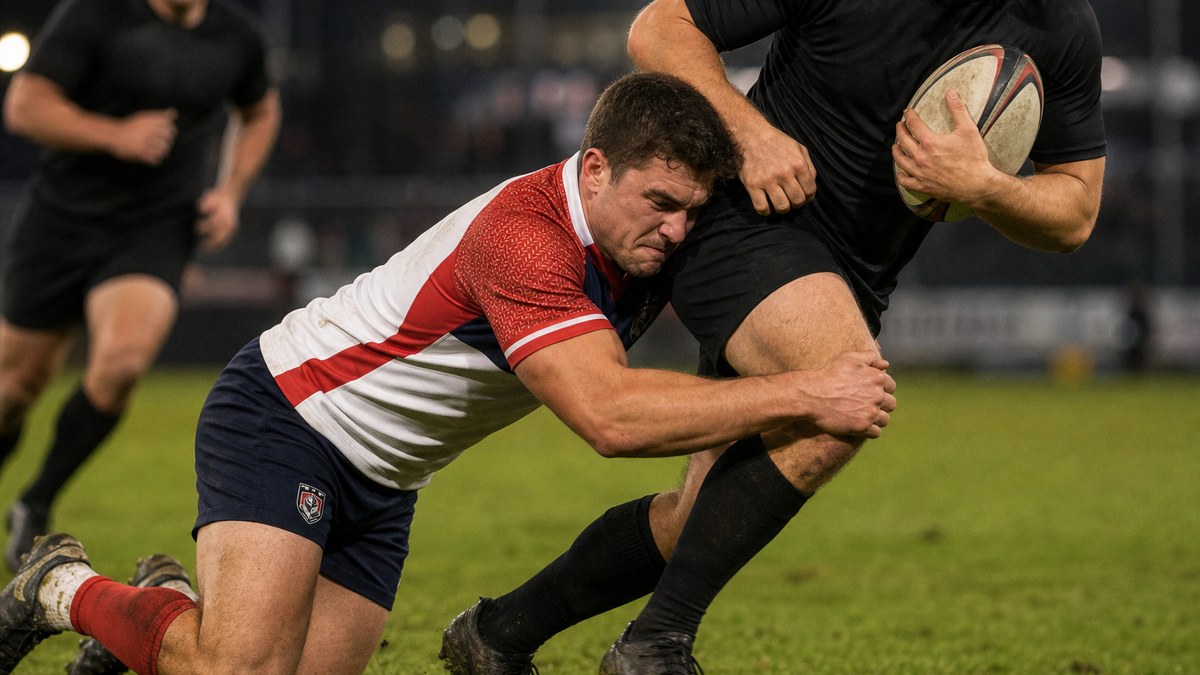
Safety note: contact skills should always be learned and practiced under a qualified coach, starting at walking pace and building up gradually. Check your competition's current laws on tackle height before you play.
How is defense different in rugby league?
Rugby league defense works differently because of the six-tackle rule. After every tackle, the tackled player plays the ball and the defending team must retreat 10 metres. The whole line then rushes forward again. That makes league defense a repeated cycle of retreat, set and charge, with a strong emphasis on line speed and holding a straight line. Union defenders, by contrast, must also contest rucks, scrums and lineouts. For a full breakdown of the two codes, read the Vegas Kings' guide to rugby union vs rugby league.
How does defense change in tens rugby?
Tens is played on a full-size pitch with fewer players a side, so each defender covers more space. That changes the math. A blitz is riskier, because any line break leaves even more empty grass behind. A drift has to cover more width with fewer bodies, so communication and fitness matter even more. Tackle completion becomes critical: one missed tackle can mean a try.
The APR Games 2027 is played as 10-a-side rugby, two 20-minute halves, May 29–31, 2027, in Las Vegas. The Vegas Knights are one of the five founding franchises. Full rules and squad sizes will be confirmed with player registration.
Defend the shield in Las Vegas
The APR Games 2027: Men's Elite ($10,000 prize pool), Women's Social ($5,000) and Youth divisions. Player entry is $299 and includes a team jersey, a full kit bag, at least three pool games and opening-night access.
Join the APR Games waitlistDefensive drills to build your system
Coaches usually teach defense in three stages: first the shape, then the triggers, then the decisions. Here is a simple progression:
- Walk-through shape (10 minutes). Set a line of defenders against a line of attackers at walking pace. Practice spacing, getting back onside and the calls: "Up!", "Hold!", "Inside!". Coaches stop and fix spacing every repetition.
- Trigger game (15 minutes). Attack against defense at jogging pace, touch only. The coach calls "blitz" or "drift" at the last moment, and the line must react together.
- Decision game (15 minutes). Remove the coach's calls. The defensive leader reads the attack and calls the system. Afterward, ask players what they saw and why they chose to rush or slide.
- 1v1 tackle grid (10 minutes, under a coach). In a narrow channel, defenders practice footwork and a low, safe tackle at controlled speed, building up gradually.
- Fitness finisher. Repeat "get back onside, set, go forward" efforts to build the conditioning a defensive line needs late in a game.
For one rugby skill broken down every week, join American Pro Rugby's free newsletter, The Breakdown, and see APR's weekly Tuesday Skills series on americanprorugby.com.
Why the Knights are a defense-first club
The Knights Code is Honor, Valor, Victory and Unity, and defense is where all four show up. Honor is staying onside when it would be easier to cheat. Valor is making the tackle on a bigger ball carrier. Unity is a line that moves together. Victory is what comes from holding that line for 40 minutes.
Want to see how other Las Vegas clubs approach the game? The Vegas Kings are home to union and league players alike, and the Vegas Blackjacks, Downtown Rugby and Vegas Lions complete the APR's five founding franchises. Coming to Las Vegas for the APR Games? Our partner Luna Appleton covers where to stay, eat and celebrate.
There is no perfect system. The best defenses are the ones whose players trust each other enough to move as one and talk enough to switch when the attack changes. Pick a system, drill it until it is automatic, then learn when to break it.
Frequently asked questions
What is the difference between blitz and drift defense in rugby?
A blitz defense rushes forward fast to pressure the receiver and force errors. A drift defense moves more patiently and slides sideways to push the attack toward the touchline. A blitz takes away time; a drift takes away space and reduces missed tackles.
What is a rush defense?
Rush defense is another name for a blitz. The whole defensive line moves up together at high speed, usually triggered by the pass, to tackle the receiver behind the gain line.
What is line speed in rugby?
Line speed is how quickly the defensive line moves forward from the offside line once the ball is available. High line speed reduces the attack's time and space and is the core of a blitz defense.
Which defense did South Africa use to win the World Cup?
South Africa used an aggressive rush defense under defense coach Jacques Nienaber on the way to winning the 2019 Rugby World Cup. They also won the 2023 final, beating New Zealand 12-11.
What is a hybrid or rush-and-fold defense?
It mixes both systems: inside defenders rush the ball while outside defenders drift to cover width, then slide back inside (fold) once the rushing defender commits.
When should a team blitz instead of drift?
Common blitz triggers include slow ball from the ruck, a flat or static receiver, a predictable attack and a scrum-half taking extra time. Teams usually stay in drift against quick ball, decoy runners and strong direct runners.
What is the legal tackle height in rugby?
It depends on the competition. In May 2023, World Rugby approved an opt-in community trial that lets unions set the legal tackle height at the base of the sternum or lower. Check your own union's current laws.
How do you tackle safely in rugby?
Tackle low, keep your head to the side of the ball carrier, wrap with both arms and drive with your legs. Learn and practice contact under a qualified coach, building up speed gradually.
How is rugby league defense different?
In league, the defense must retreat 10 metres after every tackle and then rush forward again, so it is built around repeated line speed. Union defenders must also contest rucks, scrums and lineouts.
Is defense harder in tens rugby?
Each defender covers more space in tens, so missed tackles and line breaks are more costly. Communication, fitness and tackle completion matter even more. The APR Games 2027 is played as 10-a-side rugby.
Keep reading
Sources
- The Rugby Magazine: Defensive systems, blitz or drift
- Sportplan: Defensive systems, drift vs blitz (2025)
- The Rugby Site (Nick Bishop): Why defence won South Africa the World Cup, 21 November 2019
- World Rugby Passport: Lower tackle height law trial
- Al Jazeera: South Africa hold off New Zealand to win record fourth Rugby World Cup, 29 October 2023
- NRL.com: New NRL rules explained, February 2021
- American Pro Rugby: APR Games 2027
This guide is general information, not individual coaching advice. Contact skills should be learned under a qualified coach, and laws on tackle height vary by competition and change over time; check your competition's current laws before you play. Written October 2026.