
Home › Knights News › Rugby 101
Rugby 101Breakdown defense: how to jackal and counter-ruck
Every tackle starts a race for the ball. Win it and the defense becomes the attack. Here is how the laws treat the jackal and the counter-ruck, when to compete, when to fan out, and how to train both safely.
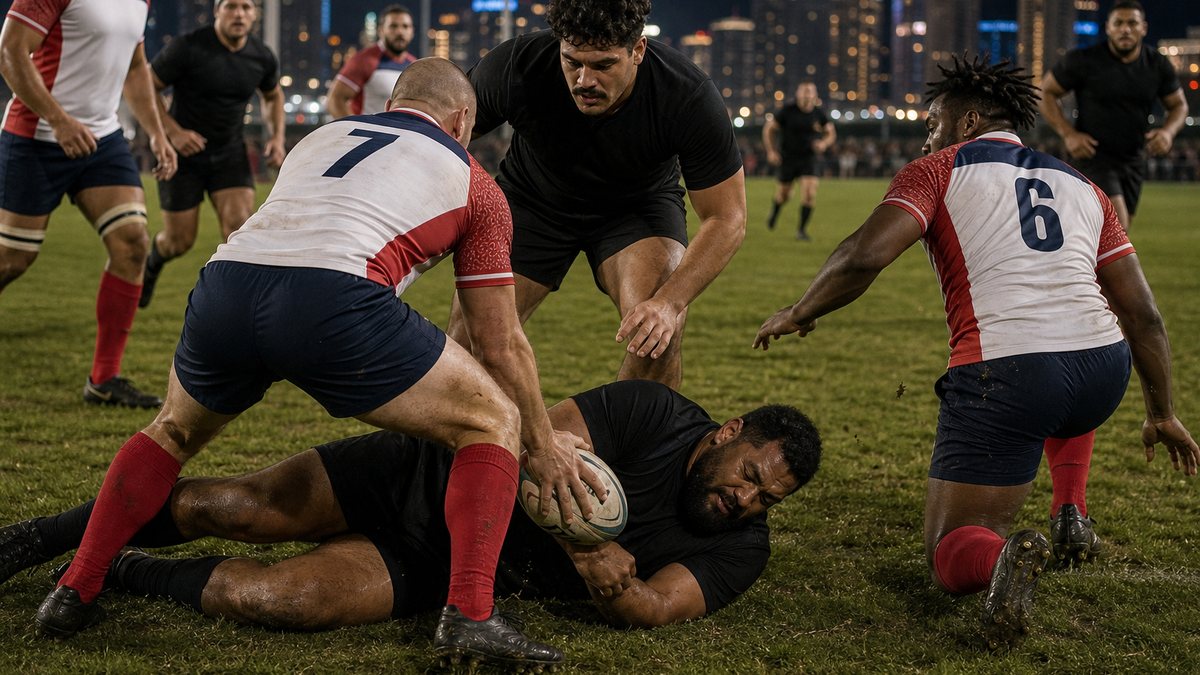
Key facts at a glance
- Hands rule: once a ruck has formed, no player may handle the ball unless they got their hands on it before the ruck formed and stayed on their feet (World Rugby Law 15.11)
- What forms a ruck: at least one player from each team in contact, on their feet and over the ball on the ground (Law 15.2)
- Jackler standard: must be in a strong position to lift, hands on the ball, and "support their body weight throughout" (World Rugby breakdown guidelines, March 2020)
- Injury context: World Rugby's chairman said in April 2020 that the breakdown is responsible for nine per cent of match injuries
- Crocodile roll banned: since 1 July 2024, cleaners may drive a jackler backwards but "must not roll, pull or twist" them (Law 9.20)
- Tackle height: community rugby moved to a lower tackle height (waist or base of sternum) for seasons starting after 1 July 2026
Our first three guides built the Knights' defensive foundation: rugby defense systems (how the line moves), how to tackle in rugby safely (how the collision happens) and rugby fitness for defenders (how you keep doing it). This one covers what happens a second after the tackle, on the ground, where games are often won and lost: breakdown defense, and specifically the two weapons a defense has there, the jackal and the counter-ruck.
The Vegas Blackjacks explained the attacking side in rugby rucking explained: how to win the contact area. Read that first if rucks are new to you. Here we flip the picture and look at the contest from the defender's side. This is general information based on World Rugby's laws and guidance, not a coaching certificate: every contact skill below should be learned under a qualified coach.
What is the breakdown in rugby?
"Breakdown" is the everyday name for the contest that follows a tackle. World Rugby's Law 14 covers the tackle itself and Law 15 covers the ruck that usually follows. In order, it goes like this:
- The tackle. The ball carrier is held and brought to ground. Under Law 14.7 the tackled player must immediately make the ball available "by releasing, passing or pushing the ball in any direction except forward", then move away or get up, and must not lie on, over or near the ball.
- The race. Before a ruck forms, a defender on their feet who arrives from their own side can try to win the ball with their hands. That is the jackal.
- The ruck. Under Law 15.2, a ruck forms when at least one player from each team is in contact, on their feet and over the ball on the ground. From then on, hands are out (Law 15.11). Possession "may be won either by rucking or by pushing the opposing team off the ball" (Law 15.10). That is the counter-ruck.
So the defender's question at every tackle is simple: can I get hands on the ball legally before a ruck forms? If yes, jackal. If the ruck has formed but the attack is thin, counter-ruck. If neither, leave it and get back in the line.
What are the tackler's jobs at the breakdown?
The tackler is usually the first defender at the ball, which makes them the most likely to be penalized. Law 14.5 says tacklers must immediately release the ball and the ball carrier once both are on the ground, "immediately move away from the tackled player and from the ball or get up", be on their feet before attempting to play the ball, and allow the tackled player to release or play it.
World Rugby's Breakdown Ready resource on breakdown laws describes the legal exit as rolling "east/west", sideways, out of the way. The tackler may only contest the ball if they are back on their feet, have shown a clear release of the ball and the player, and come back in from the direction of their own goal line. In practice that means: let go, roll away or bounce up, step back to your side of the ball, then compete. Anything else, such as holding on, staying on the ball or playing it from the ground, is a penalty.
Good tackling makes all of this easier. A low, dominant tackle, with the head to the side and the defender driving through, puts the ball carrier on their back and gives the tackler time to get up. Remember the law on tackle height: World Rugby approved a lower community tackle height into full law on 17 June 2026, for seasons starting after 1 July 2026, with competitions choosing the base of the sternum or the waist. And from 1 November 2026, World Rugby has added the hip-drop tackle to the dangerous play law (Law 9.13), with the knee drop treated as leaving your feet to make a tackle. Our safe tackling guide covers the technique.
The best jackal starts with the tackle. A tackler who hits low, rolls away fast and is first back on their feet has already won half the race. Discipline is the other half: release, roll, reload. Every time.
What is a jackal in rugby?
A "jackler" (also spelled jackaller, or called a "poacher" or "fetcher") is the defender who wins the ball on the ground after a tackle. World Rugby's March 2020 breakdown guidelines define the jackler as "a player who wins possession of the ball before a ruck forms". Those guidelines, applied in international rugby from July 2020, told referees to "reward the player who wins the race for possession" and set clear standards:
- The jackler must arrive on their feet and join from behind their offside line, through the "gate".
- They must be "in a strong position to try and lift, with hands on the ball".
- They must "support their body weight throughout", with no going to ground and then resetting, and no leaning on the tackled player.
- Referees were told to remove the old idea of the jackler having to "survive the clear out". If the jackler is legal and lifts the ball, they should be rewarded.
Breakdown Ready adds that a jackler "must target the ball and lift it legally", can use a "clamp" technique when the ball player falls on top of the ball, and "if deciding not to contest, must counter ruck in a legal manner". If the jackler gets their hands on the ball before the ruck forms and stays on their feet, they keep the right to play it even after opposition players arrive (Law 15.11). If the tackled player then holds on, the referee will usually penalize the attack for not releasing.
How to jackal: the technique, step by step
- Read the tackle. Is it dominant (ball carrier going backwards, support far away) or passive (carrier falling forward, support close)? Only go for a dominant tackle where you can win the race.
- Enter through the gate. Come in from your own side, square to the ball, not from the side.
- Build a strong base. Feet wide and planted beside the tackled player, knees bent, hips low and behind the ball.
- Flat back, head up. Spine long and neutral, chin up, eyes on the ball. A rounded back and dropped head is both weak and unsafe when a cleaner arrives.
- Hands on the ball, not the body. Grip the ball itself and immediately try to lift it toward your own side. Do not hold the tackled player or lean your weight on them.
- Win it or let it go. If the ball comes up, play it. If a ruck has clearly formed and you have not got it, take your hands off and either counter-ruck or rejoin the line.
Safety note: the jackal position puts a defender's head and neck in the path of arriving cleaners. Learn it under a qualified coach, start with no opposition, then add a cleaner holding a shield at walking pace, and only progress to live contest when technique is solid. Players of different size and experience should not be paired for contested breakdown work. If any player shows signs of a possible concussion, recognise and remove, and follow your union's concussion protocol. This article is not medical advice.
Is the crocodile roll still legal?
No. The "crocodile roll" was a clear-out where an attacker grabbed the jackler and twisted them sideways to the ground. World Rugby's law changes of 1 July 2024 banned it. Law 9.20 now says a player may remove a jackler by pushing or driving them backwards, including by grabbing a leg, "but must not roll, pull or twist an opponent". A new Law 9.20(e) says a player must not drop their weight onto an opponent or target the lower limbs, and Law 14.8 adds the same "roll, pull or twist" ban for players involved in the tackle. All are penalties.
For jacklers this is good news: the most dangerous way of removing you is illegal. It does not make the position risk-free. Cleaners can still legally drive you backwards, so a strong, low, flat-backed position is your protection. World Rugby's concern is long-standing: when it issued the March 2020 guidelines, then chairman Sir Bill Beaumont said the breakdown "is responsible for nine per cent of match injuries" (as reported by RugbyPass, 2 April 2020).
What is a counter-ruck?
A counter-ruck is a defensive drive over the ball once a ruck has formed. Because hands are no longer allowed (Law 15.11), the defense wins the ball by pushing the attackers off it, so that the ball ends up behind the defenders' feet where their scrum-half can play it. Law 15.10 says possession "may be won either by rucking or by pushing the opposing team off the ball", and Law 15.14 allows players to play the ball with their feet "in a safe manner".
World Rugby's Breakdown Ready defensive cues describe it as one of the options when a tackle is dominant: "counter ruck using good technique through body height and leg drive" to beat the attacking cleaners. Analyst Nick Bishop, writing on The Rugby Site in October 2021, described the key moments: the first defender gets "some forward momentum on to the tackle ball", establishes themselves in the space above the ball carrier "with lower leverage than their immediate opponent", and a second defender joins as the "engine" to drive across the center line.
How to counter-ruck: the technique
- Arrive on your feet from behind your offside line, through the gate (Law 15.5). Join alongside, not in front of, the hindmost teammate.
- Get lower than the cleaner. Hips below shoulders, flat back, head up and in line with the spine. The lower player usually wins the drive.
- Bind and drive. Bind on a teammate or an opponent with a full arm, and drive with short, fast leg steps through the ball, not down onto the ground.
- Two is stronger than one. A single counter-rucker against two cleaners rarely wins. The second defender (the "engine") doubles the drive.
- Stay on your feet. Law 15.12 says players must try to remain on their feet throughout the ruck. Diving in or going to ground is a penalty and a safety risk.

| Jackal | Counter-ruck | |
|---|---|---|
| When | Before a ruck forms | After a ruck forms |
| Hands on the ball? | Yes, must get them on before the ruck forms | No (Law 15.11) |
| Body position | Feet wide, hips low, flat back, supporting own weight | Bound, lower than opponent, leg drive forward |
| Best moment | Dominant tackle, attacking support slow or far away | Thin ruck, attackers arriving high or late |
| Typical players | Openside flanker, tackler who bounces up, any quick-reacting defender | Back-row and second-row forwards, often in pairs |
| Main risks | Being cleaned out; penalty for hands in the ruck or leaning on the tackled player | Going off feet; side entry; leaving the defensive line short |
| Reward | Turnover or penalty for "not releasing" | Turnover, slow ball for the attack, or a scrum |
Based on World Rugby Laws 14 and 15, the March 2020 breakdown law application guidelines and the Breakdown Ready resources on World Rugby Passport (accessed November 2026). Not a substitute for your competition's laws or a qualified coach.
When should a defense compete, and when should it fan out?
The breakdown is a numbers game. Every defender who commits to the ball is a defender not in the line. Commit two and lose the contest, and the attack has a free ruck against a defense that is two short. That is why World Rugby's Breakdown Ready defensive cues split decisions by tackle type:
- Tackle dominant (carrier going backwards): the tackler gets up and "competes for ball / counter-rucks"; inside or outside support can rip the ball, jackal if the tackler has rolled out, or counter-ruck. If the attack's support is late or inaccurate, the decision is made to jackal or counter-ruck.
- Tackle passive (carrier falling forward): the tackler "rolls immediately East/West and returns to defensive line", the support may get a quick clamp on the ball or go straight back into the system, and the line fills gaps to stop the next attack, such as a pick and go.
Most teams make the call with a simple word: one player shouts "ball" or "jackal" to say they are competing, and everyone else fans out. A good rule of thumb for club teams is one competitor at most, two only when the tackle is clearly dominant. The rest of the line folds around the ruck and gets set, ready for line speed on the next phase.
A turnover is the best defensive play in rugby, but a lost breakdown contest is one of the worst. We would rather have 14 defenders in a connected line than 13 and a hopeful hand on the ball. Compete when the tackle tells you to, not because you feel like it.
Who should jackal and counter-ruck?
Anyone can win a turnover, but some positions do it most. The openside flanker (number 7) is traditionally the breakdown specialist, because they are usually the fastest forward to the tackle. The other back-rowers (6 and 8) and the second rows (4 and 5) supply much of the counter-ruck power. Backs who tackle can jackal too, especially a tackler who bounces up quickly or a center who arrives first. The Vegas Kings' guide to rugby positions explained covers what each number does.
It also helps to understand the attackers you are competing against. The Vegas Lions explain how good ball carriers fall and place the ball in the rugby carry: run hard lines and win the collision. A carrier who lands on their back with the ball placed long is hard to jackal. One who is turned and held up is a gift. And if the attack sets a maul instead, the rules change again: see the Blackjacks' guide to the rolling maul.
What gives away penalties at the breakdown?
Breakdown penalties are among the most common in the game, and they are often the ones that let the other team kick for touch or for goal. For defenders, the usual culprits are:
- Tackler not releasing or not rolling away (Law 14.5).
- Hands in the ruck: handling the ball after a ruck has formed without having got there first (Law 15.11).
- Off the feet: playing the ball while on the ground, or diving into the ruck (Laws 14.8, 15.12, 15.15).
- Side entry: joining the breakdown from the side rather than through the gate. The 2020 guidelines told referees to "enforce the tackle gate and penalise side entries".
- Not supporting your own weight as a jackler, or going to ground and resetting.
- Offside at the ruck: defenders not involved in the ruck must be behind the hindmost foot.
- Falling on the ball as it emerges near the ruck (Law 15.16).
Referees also manage the end of the contest. In Law Clarification 2-2026 (1 June 2026), World Rugby said that when a scrum-half moves the ball with their hands from just beyond the back of a ruck there is "no material offence" and referees are prioritizing continuity, but only "when the contest is clearly over". The lesson for defenders: once the ball is clearly won, stop competing and get back in the line.
Honor in the Knights Code starts here. A penalty at the breakdown is three points or 30 meters handed to the other team. Clean hands, on your feet, through the gate: that is discipline you can see from the stands.
Breakdown defense drills (a safe progression)
These drills follow the progression in World Rugby's Breakdown Ready and Tackle Ready resources: technique first, then controlled opposition, then decision-making. Run them under a qualified coach, match players by size and experience, and keep the intensity low until shapes are right.
1. Jackal shape on a static ball
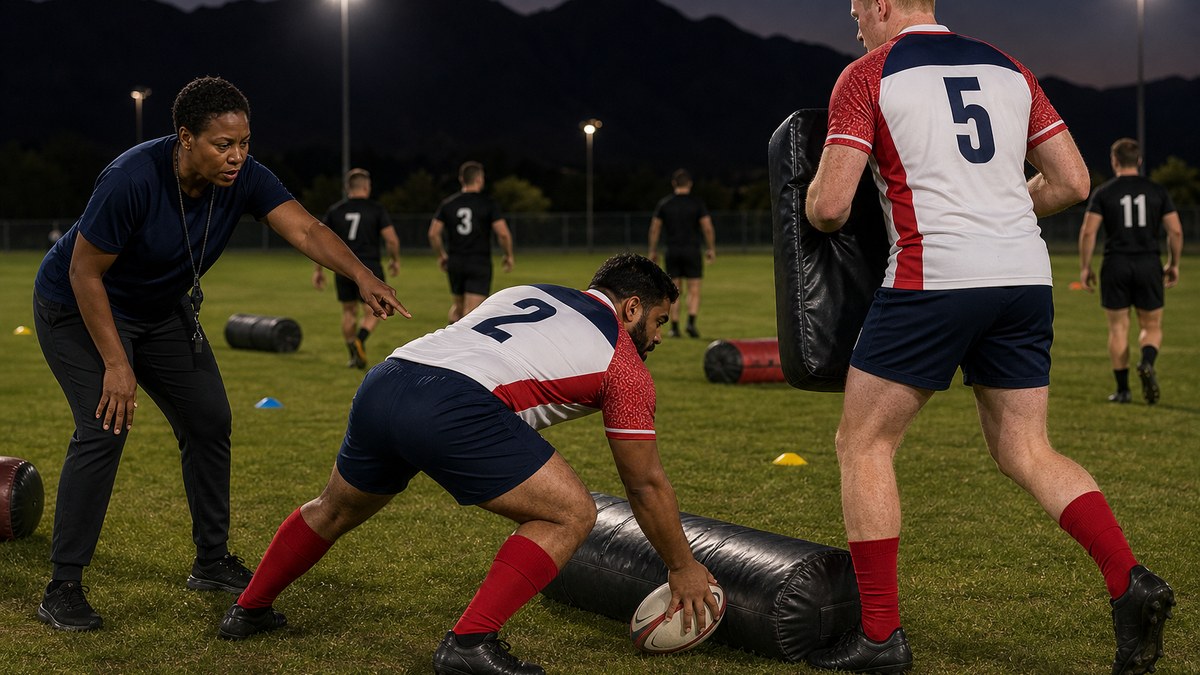
A ball sits beside a tackle bag on the ground. On the call, the player steps in through a cone "gate", sets a wide base, flat back and head up, puts both hands on the ball and lifts it. Coach checks: feet, hips, spine, hands on ball, no weight on the bag. Five to eight reps, full recovery.
2. Jackal with a walking cleaner
Same set-up, but a teammate holding a contact shield walks in from the attacking side and pushes the jackler backwards. The jackler learns to hold a strong shape, lift quickly and let go when the push wins. No grabbing, rolling or twisting, ever.
3. Counter-ruck pairs on shields
Two attackers hold shields over a ball. Two defenders bind together, get lower than the shields and drive them back two or three meters until the ball is behind their feet. Focus on body height and short, powerful steps.
4. Compete or fold
The coach rolls a ball and calls "dominant" or "passive". On "dominant", the nearest defender competes and calls "ball"; on "passive", everyone folds into a defensive line. Build it into small-sided games so players read real tackles, with touch or shields at the contact point.
5. Tired breakdowns
Finish a conditioning set with a few controlled jackal reps. Shape breaks down when legs are tired, which is when penalties and injuries happen in games. Stop and reset when technique slips. Our fitness for defenders guide has the conditioning side.
Breakdown defense in tens rugby
In 10-a-side rugby the breakdown decision matters even more. With fewer defenders, committing one player to a lost contest can leave a hole the attack runs straight through. Many tens teams compete selectively, only on clearly dominant tackles, and keep the line full the rest of the time. When a turnover does come, there is space everywhere, so a quick jackal can turn into a try.
The APR Games 2027 is played as 10-a-side rugby, two 20-minute halves with evening kickoffs, Memorial Day weekend, May 29–31, 2027, in Las Vegas. The Vegas Knights are one of five founding franchises, alongside the Vegas Kings, the Vegas Blackjacks, Downtown Rugby and the Vegas Lions, plus one invitational team still to be revealed. Meet them on the APR teams page. Full rules and squad sizes will be confirmed with player registration.
Coaches can look out for the APR coaching clinic, May 28–31, 2027, in Las Vegas, and APR's Tuesday Skills series on americanprorugby.com. For world rugby headlines, including law news, see APR's global rugby news.
Defend the shield in Las Vegas
The APR Games 2027: Men's Elite ($10,000 prize pool), Women's Social ($5,000) and Youth divisions. Player entry is $299 and includes a team jersey, a full kit bag, at least three pool games and opening-night access.
Join the APR Games waitlistHow do you track breakdown defense?
You cannot improve what you do not count. Simple numbers any club can log from video or the sideline: turnovers won at the breakdown, breakdown penalties conceded (split by type), how many defenders commit per ruck, and how often the attack gets quick ball (for example, ball out in under three seconds). Track them over a few weeks and the patterns jump out: a team giving away "hands in the ruck" penalties needs a clearer call, not more aggression.
If your club wants a simple app or spreadsheet tool to log these stats on match day, our APR partner Vibe Coding covers building tech and apps. For one rugby skill and one strength block every week, join APR's free newsletter, The Breakdown. New to the laws altogether? Downtown Rugby's rugby rules for beginners is the place to start.
Why the breakdown is at the heart of the Knights Code
Honor, Valor, Victory and Unity all show up over the ball. Honor is staying on your feet and keeping your hands out when the ruck has formed. Valor is putting your body in a strong, legal position over the ball when you know a cleaner is coming. Unity is the call, "ball" or "fold", that tells 14 teammates what to do. And Victory, more often than not, is the turnover that flips a game. Train it right, and the shield does not just hold: it strikes back.
Want the kit for training? Team gear is on the APR merch store.
Frequently asked questions
What does jackal mean in rugby?
To jackal is to win the ball on the ground after a tackle, before a ruck forms. The defender must be on their feet, arrive from their own side, support their own weight and lift the ball with their hands.
Can you use your hands in a ruck?
No. Under World Rugby Law 15.11, once a ruck has formed no player may handle the ball, unless they got their hands on it before the ruck formed and stayed on their feet.
What is the difference between a jackal and a counter-ruck?
A jackal uses the hands to win the ball before a ruck forms. A counter-ruck happens after the ruck forms and uses no hands: defenders drive the attackers backwards off the ball.
When does a ruck form?
A ruck forms when at least one player from each team is in contact, on their feet and over the ball on the ground (Law 15.2).
Can the tackler compete for the ball?
Yes, but only after releasing the ball and the tackled player, getting back on their feet and arriving from the direction of their own goal line, and only before a ruck has formed.
Is the crocodile roll illegal?
Yes. Since 1 July 2024, a player clearing out a jackler may push or drive them backwards but must not roll, pull or twist them to the ground. It is a penalty.
Is jackaling dangerous?
The jackal position puts the head and neck near arriving cleaners, and World Rugby has said the breakdown accounts for around nine per cent of match injuries. Learn it gradually under a qualified coach with a strong, low, flat-backed position.
How many defenders should go into a ruck?
Usually as few as possible. Many teams send one competitor on a dominant tackle and fan everyone else into the line. Committing players to a lost contest leaves the defense short.
Which position is best at jackaling?
The openside flanker (number 7) is traditionally the breakdown specialist, but any defender who arrives first and legally can win a turnover, including backs.
Why do referees penalize jacklers for not supporting their weight?
World Rugby's breakdown guidelines require jacklers to support their own body weight throughout. Leaning on the tackled player or going to ground and resetting is illegal and unsafe.
Keep reading
Sources
- World Rugby Passport: Law 14, Tackle (accessed November 2026)
- World Rugby Passport: Law 15, Ruck (accessed November 2026)
- World Rugby: Enforcement of current law, refereeing at the breakdown, March 2020
- World Rugby Breakdown Ready: Breakdown laws, dos and don'ts (accessed November 2026)
- World Rugby Breakdown Ready: Defensive cues (accessed November 2026)
- World Rugby: Law changes, 1 July 2024 (crocodile roll)
- World Rugby: Law Clarification 2-2026, 1 June 2026
- World Rugby: Community tackle height law wordings approved, June 2026
- World Rugby: World Rugby clarifies law on dangerous tackles, 7 October 2026
- RugbyPass: World Rugby issue edict on the breakdown, 2 April 2020
- The Rugby Site (Nick Bishop): Why the counter-ruck is gaining currency on defence, 14 October 2021
- American Pro Rugby: APR Games 2027
This guide is general information, not individual coaching or medical advice. Breakdown and contact skills should be learned and progressed under a qualified coach, and players should get clearance from a qualified professional after injury or illness. Laws, trials and tackle-height rules vary by competition; check your competition's current laws. Written November 2026.