
Home › Knights News › Training
TrainingRugby fitness for defenders: conditioning for repeat efforts
Defense is not one big tackle. It is tackle, get up, get back onside and go again, often three or four times inside 20 seconds. Here is what the research says about repeat efforts in rugby, and how defenders can train for them.

Key facts at a glance
- The definition: a repeated high-intensity bout is three or more sprints, tackles or scrum/ruck/maul efforts within 21 seconds (Austin, Gabbett and Jenkins, 2011)
- How often: in Super 14 rugby, front rows made 11–18 bouts a match, back rows 11–21, inside backs 13–18 and outside backs 2–11 (same study)
- The toughest passages: the most intense bouts lasted from 53 to 165 seconds, with as little as 25 seconds between bouts for back-row forwards
- Backs defend too: about 35% of backs' repeat-effort bouts are made up of tackles (Vachon et al., 2020)
- Averages hide the peaks: international players work much harder while the ball is in play than whole-match numbers suggest (Pollard et al., 2018)
- Recovery matters: World Rugby says players can still be fatigued 48 hours after an intense game
In our first two guides we covered rugby defense systems: blitz, drift and line speed and how to tackle in rugby safely. Both depend on one thing coaches see every weekend: the defensive line looks sharp on phase one and ragged on phase five. That is a fitness problem as much as a tactical one. This guide is about rugby fitness for defenders, and specifically conditioning for repeat efforts.
At the Vegas Knights, "Defend the Shield" means the shield has to hold for the whole passage of play, not just the first collision. Below we look at what repeat efforts are, why defenders feel them most, how recent law trials have pushed the game toward more continuous play, and a practical, safe way to train for it. This is general information, not a personal training plan or medical advice: work with a qualified coach, and learn every contact drill under supervision.
What is a repeated high-intensity effort in rugby?
Sports scientists studying rugby noticed that average running numbers did not explain why players got so tired. The hard part of rugby is clusters of work: a sprint, a tackle, a ruck, another sprint, all with only a few seconds between them. In a 2011 study in the Journal of Sports Sciences, Damien Austin, Tim Gabbett and David Jenkins analyzed seven Super 14 matches from the 2008 and 2009 seasons and defined a repeated high-intensity bout as three or more sprints, tackles or scrum/ruck/maul activities within 21 seconds.
They found every position group had to produce these bouts, many times a game. During the most intense bouts, players averaged at least 10 changes in activity, at least one tackle and at least two sprints. World Rugby Passport's advanced conditioning course uses the same research to set conditioning targets, and notes that across a match "none of the three energy systems ever switch off".
A 2020 study in the journal Sports, led by Adrien Vachon with elite under-21 players from a French Top 14 club, used a similar definition: three or more intense accelerations, sprints or contact efforts with less than 21 seconds of recovery between them. It reported that forwards' repeat-effort bouts are mostly scrums, rucks and mauls (about 50%) and sprints (about 30%), while backs' bouts are mostly sprints (about 45%) and tackles (about 35%). In other words, repeat efforts are a defensive problem for every number on the team sheet, not only the forwards.
| Position group | Repeat-effort bouts per match | What dominates the bouts |
|---|---|---|
| Front-row forwards | 11–18 | Scrums, rucks and mauls, plus short sprints |
| Back-row forwards | 11–21 | Tackles, rucks and sprints; shortest recovery between bouts (25 s minimum) |
| Inside backs | 13–18 | Sprints and tackles close to the ruck |
| Outside backs | 2–11 | Longer sprints, kick chase and cover tackles |
Bout counts: Austin, Gabbett and Jenkins, Journal of Sports Sciences, 2011 (Super 14, 2008–09). Bout make-up: Vachon et al., Sports, May 2020. Locks were not reported as a separate group in the 2011 study.
Why do defenders tire faster than attackers?
The attacking team chooses when to run, pass, kick or set a ruck. The defending team has to react to every one of those choices. After each tackle, the defender has to release, roll away, get back to their feet and retreat behind the offside line before they can move forward again. Then the whole line has to reset its spacing and push up together. If one player is slow off the ground, the line has a hole in it.
Sportplan's April 2026 coaching guide on defensive line speed makes the same point from the coaching side: line speed is collective, one defender rushing ahead or lagging behind opens a gap, and defensive sets should be practiced at the end of training, when players are already tired.
Contact also changes how much running players have left. In a 2014 study in the Journal of Strength and Conditioning Research, Rich Johnston, Tim Gabbett and colleagues had 12 semi-professional rugby league players play small-sided games with one, two or three contact efforts every two minutes. The authors reported that running intensity was "progressively reduced as the number of contact efforts per bout is increased". In the triple-contact game, relative distance dropped by a moderate amount from the first half to the second. The sample was small and the games were controlled drills, not full matches, but the message is consistent with what coaches see: the more you tackle, the less you can run, unless you have trained for both together.
Finally, averages hide the hard bits. A 2018 study by Ben Pollard and colleagues in the Journal of Science and Medicine in Sport used GPS data from 22 international players across eight 2016 Test matches. Whole-match work rates were significantly lower than the work rates recorded while the ball was actually in play, and forwards made more collisions per minute than backs. Conditioning built around whole-game averages will leave defenders short in the passages that decide matches.
The tackle that wins the game is rarely the first one. It is the fourth tackle in a long phase, when your lungs are burning and the attack has found a tired defender. We train for that tackle on purpose, because that is where the shield cracks or holds.
Is rugby getting faster for defenders?
World Rugby has spent the last few seasons trialing laws designed to cut stoppages. Global law trials approved by the World Rugby Council on 14 November 2024 and applied from 1 January 2025 included a 60-second limit for conversions, a 30-second limit for teams to form a lineout (in line with the existing 30-second scrum guideline), protection for the scrum-half at the base of the ruck, maul and scrum to allow "more ball in flow", and fewer stoppages for crooked lineout throws when the other team does not contest.
The aim was quicker restarts and more continuous play. For defenders, the practical effect is fewer natural breathers: a shorter wait at the lineout, less time to recover after a try, and a scrum-half who can get the ball away faster from the ruck. Whatever level you play, it is a good reason to train for repeat efforts rather than for single big moments. Always check which laws and trials your own competition is using.
What should defenders train?
World Rugby's Rugby Ready guidance lists the main fitness components as speed, strength, endurance, functional competence (stability and mobility in rugby movements) and power, and says the emphasis changes by position: front-row players need power and endurance for scrummaging, while flankers need speed and speed endurance. It also states that "improving your fitness can make you a better player and less prone to injury".
For defenders, those components show up in five practical qualities:
- An aerobic base. Most of a game is spent at low speed. World Rugby Passport cites research on elite men showing most distance is covered between 0 and 12 km/h. A strong aerobic engine is what lets you recover between bouts while you jog back into the line.
- Repeat-sprint ability. Short, hard accelerations to close down space. World Rugby Passport describes repeated sprint training as sprints of 3–7 seconds, "generally at a 1:3 work-to-rest ratio".
- Getting up fast. Getting off the ground is a skill and a fitness quality. Train it like one: from the front, the back, the side, after a tackle bag, every time with a sprint to finish.
- Contact under fatigue. The goal is the same low, head-to-the-side tackle shape on the last rep as on the first. That only happens if technique is practiced while tired.
- Strength and stability. Legs and hips that can sink and drive, and a strong trunk, shoulders and neck, help players hold a safe shape in contact. See the Vegas Lions' guide to strength training for rugby and their plyometrics guide for the power side.
If you are starting from scratch before a season, the Vegas Kings have a full 6-week pre-season conditioning plan for union and league. Think of this article as the defensive add-on to that plan.
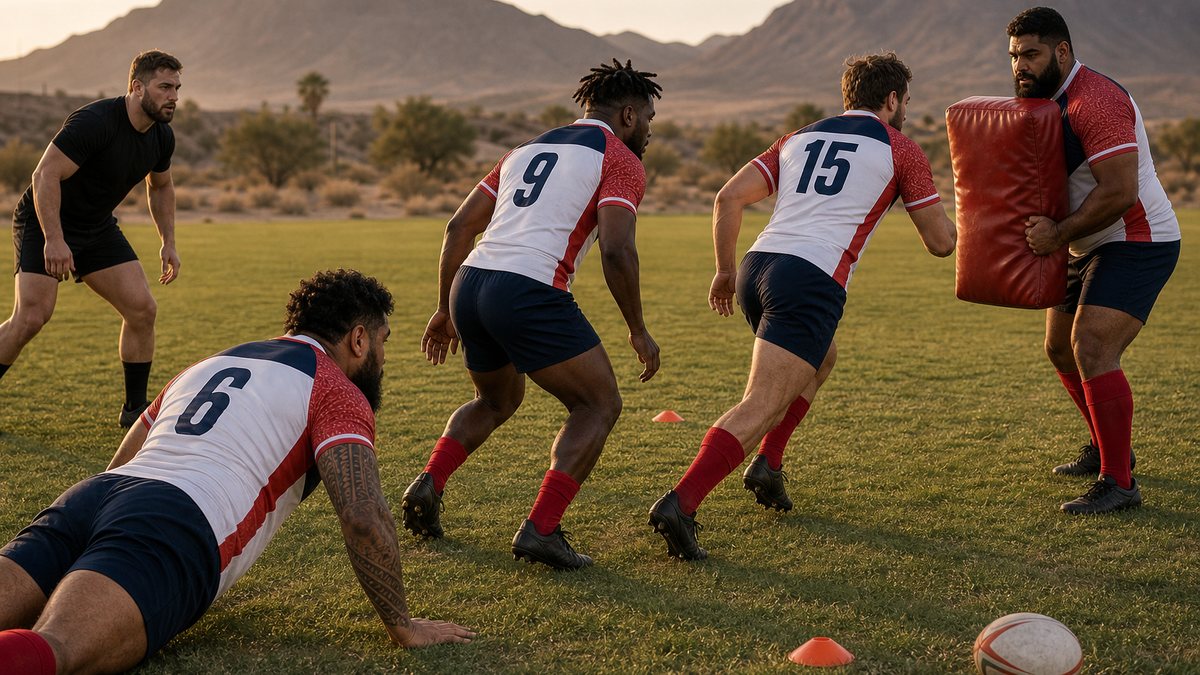
Repeat-effort drills for defenders: a safe progression
The drills below are built on the principles in World Rugby's conditioning resources and in coaching guides such as Sportplan's: short work, planned rest, and contact introduced gradually. Run them under a qualified coach, pair players by size and experience, and only add contact once technique holds at low speed.
1. Get-up and go (no contact)
Players start lying face down, face up or on their side. On the call, they get up as quickly as possible, backpedal or turn to a cone five meters back (the "offside line"), then sprint forward 10 meters. Work about 5–7 seconds, rest about three times as long. Start with a few reps and build gradually.
2. Line-speed shuttles
Groups of four or five defenders stand in a loose, staggered line. The coach calls "set", players get square and low, then push up together for 10 meters, check, and retreat to the start. The aim is to stay connected: each player should be able to see the shoulder of the player inside and outside. Repeat three times as one "bout", then walk to recover.
3. Sprint-and-bag bouts
This is based on the repeated-effort test used in the Vachon study, where elite players did 12 reps of a 20 m sprint followed by a tackle onto a tackle bag, starting a rep every 30 seconds. For club players, start with half that volume, at controlled speed, onto a bag or shield rather than a person, and only when tackle technique is already solid. Focus on the same low shape on every rep.
4. Small-sided defensive games
Play 4v3 or 5v4 in a narrow channel, with touch or shields at the contact point. The attack keeps the ball for a set number of phases; defenders must get up, realign and push up every phase. Keep the games short (two to three minutes) with full recovery between, and score the defense for connected line speed, not just turnovers.
5. Tired tackles
Finish a conditioning block with a few walking or shield tackles. If the shape breaks down, stop and reset. This is where players learn to stay low when their legs are gone, which is exactly when high, dangerous tackles happen.
Safety note: all contact skills, including tackle bags and shields, should be learned under a qualified coach, starting slowly and building up. Players returning from injury or illness should get clearance from a qualified professional before conditioning or contact work. If any player shows signs of a possible concussion, follow "recognise and remove" and your union's concussion protocol. This article is not medical advice.
| Session block | Example content | Why defenders need it |
|---|---|---|
| Aerobic base | Longer, steady runs or extensive tempo running early in the off-season | Faster recovery between bouts while jogging back into the line |
| Repeat sprints | Sprints of 3–7 s at about a 1:3 work-to-rest ratio (World Rugby Passport) | Closing down space again and again |
| Get-up drills | Get-up and go from different positions, finish with a sprint | Back onside before the next phase |
| Contact under fatigue | Sprint-and-bag bouts or shield work at controlled speed | Low, safe tackle shape late in a long phase |
| Game-based conditioning | Short small-sided defensive games with shields or touch | Repeat efforts plus communication and decisions |
| Recovery | No high-intensity training for about 48 hours after an intense game (World Rugby) | Fresh legs for the next match |
Do not run laps and call it rugby fitness. Every conditioning rep for a defender should end with something rugby-shaped: a get-up, a realign, a shield hit, a call to the player beside you. Fitness that does not show up in the defensive line is wasted.
How do you measure repeat-effort fitness?
You do not need a sports science lab. The Vachon study tested a 12-rep sprint-and-tackle protocol on elite players and found that total sprint time was the most reliable result (an intraclass correlation of 0.95 between tests a week apart), while the percentage drop-off across reps was much less reliable. For a club, that suggests a simple approach: run the same repeat-sprint or get-up circuit every few weeks, under the same conditions, and track the total time rather than obsessing over the fade.
Other simple markers coaches use are how quickly players are back in the defensive line in game footage, missed tackles late in halves compared with early, and whether the line stays connected in the last minutes of training games. For one rugby skill and one strength block every week, join APR's free newsletter, The Breakdown.
Recovery, fuel and the Las Vegas heat
World Rugby's Rugby Ready guidance says players "can still be fatigued 48 hours after an intense game" and recommends avoiding high-intensity training for 48 hours after a game. It also stresses that training should progress gradually and that players coming back from a break need to recondition before returning to full training. Sleep, rest days and sensible scheduling are part of conditioning, not a break from it.
Fuel and hydration matter too, but get specific advice on nutrition and supplements from a qualified professional. Our APR partner Clann13 makes supplements for athletes; as with any product, check with a professional what is right for you.
Training in the desert adds another layer. Heat makes repeat efforts harder and raises the risk of heat illness. The CDC's guidance on heat and athletes covers risk factors, hydration and training precautions: follow it, train in cooler parts of the day where you can, and stop if a player shows signs of heat illness.
Repeat efforts in tens rugby
Tens rugby uses fewer players on the field, so each defender covers more grass and gets fewer chances to hide. In 15s, the defenders who are not involved in a phase can catch their breath; in tens, more players are in every phase. That makes getting off the ground and back into the line even more important, and it rewards squads that rotate players well.
The APR Games 2027 is played as 10-a-side rugby, two 20-minute halves with evening kickoffs, Memorial Day weekend, May 29–31, 2027, in Las Vegas. The Vegas Knights are one of the five founding franchises, alongside the Vegas Kings, the Vegas Blackjacks, Downtown Rugby and the Vegas Lions, plus one invitational team still to be revealed. Meet them on the APR teams page. Full rules and squad sizes will be confirmed with player registration.
Coaches who want to go deeper can look out for the APR coaching clinic, May 28–31, 2027, in Las Vegas, and APR's Tuesday Skills series on americanprorugby.com.

Defend the shield in Las Vegas
The APR Games 2027: Men's Elite ($10,000 prize pool), Women's Social ($5,000) and Youth divisions. Player entry is $299 and includes a team jersey, a full kit bag, at least three pool games and opening-night access.
Join the APR Games waitlistHow the contact area connects to defensive fitness
Every tackle creates a contest on the ground, and the defense decides in a second whether to compete or fan out. Players who commit to the breakdown then have to get back into the line, which is another repeat effort. The Vegas Blackjacks explain the attacking side of that contest in rugby rucking explained, and the Vegas Lions break down the ball carrier's job in the rugby carry. Read them from a defender's point of view: every hard carry and fast ruck is a repeat effort you will have to answer.
New to the sport? Start with Downtown Rugby's guide on how to start playing rugby as an adult, build fitness gradually, and add contact under a coach.
Why repeat efforts are the heart of the Knights Code
The Knights Code is Honor, Valor, Victory and Unity. Repeat efforts test all four. Honor is getting back onside every time, even when nobody is watching. Valor is making the fourth tackle as hard as the first. Unity is knowing the player beside you will be up and in the line, because they trained for it too. Victory comes from a shield that holds for 80 minutes, or 40 in tens.
Want the gear for training? Team kit is on the APR merch store. And if you are traveling to Las Vegas for the Games, our partner Luna Appleton covers where to stay, eat and celebrate after the final whistle.
Fitness is a defensive weapon. The team that gets off the ground first gets to decide where the next collision happens. Train the get-up, train the realign, and the shield takes care of itself.
Frequently asked questions
What is a repeated high-intensity effort in rugby?
It is a cluster of hard work with very little rest: usually three or more sprints, tackles or scrum, ruck and maul efforts within 21 seconds, as defined by Austin, Gabbett and Jenkins in 2011.
How many repeat-effort bouts happen in a rugby match?
In a study of Super 14 rugby, front rows made 11 to 18 bouts a match, back rows 11 to 21, inside backs 13 to 18 and outside backs 2 to 11. Numbers vary by level and game.
Why do defenders get more tired than attackers?
Defenders react to every attacking choice, and after each tackle they must get up, retreat behind the offside line and realign before pushing up again. Research also shows running drops as the number of contacts rises.
What is the best conditioning for rugby defenders?
A mix of an aerobic base, short repeat sprints, get-up drills, controlled contact under fatigue and strength work, built up gradually under a qualified coach.
What work-to-rest ratio should repeat sprints use?
World Rugby Passport describes repeated sprint training as sprints of 3 to 7 seconds, generally at a 1:3 work-to-rest ratio. A coach should adapt it to your level.
Should I practice tackling when I am tired?
Yes, but safely. Finish some sessions with walking or shield tackles so you learn to stay low when fatigued, and stop and reset if technique breaks down. Always do this under a qualified coach.
How long should I rest after a hard rugby game?
World Rugby's Rugby Ready guidance says players can still be fatigued 48 hours after an intense game and recommends avoiding high-intensity training for 48 hours afterward.
How can a club test repeat-effort fitness?
Run the same repeat-sprint or sprint-and-bag circuit every few weeks under the same conditions and track total time, which research found to be the most reliable measure.
Is fitness more important in tens rugby?
Each defender covers more space and is involved in more phases with fewer players on the field, so repeat-effort fitness and rotating players well matter a lot. The APR Games 2027 is played as 10-a-side rugby.
Have rugby law changes made the game faster?
World Rugby's global law trials from 1 January 2025 aimed to cut stoppages, including a 30-second limit to form a lineout and a 60-second limit for conversions. Check which laws your competition uses.
Keep reading
Sources
- Austin, Gabbett and Jenkins: Repeated high-intensity exercise in professional rugby union, Journal of Sports Sciences, 2011
- Vachon et al.: Reliability of a Repeated High-Intensity Effort Test for Elite Rugby Union Players, Sports, 22 May 2020
- Johnston, Gabbett et al.: Are three contact efforts really reflective of a repeated high-intensity effort bout? Journal of Strength and Conditioning Research, 2014
- Pollard et al.: The ball in play demands of international rugby union, Journal of Science and Medicine in Sport, 2018
- World Rugby Passport: Physical capacities for rugby conditioning (accessed October 2026)
- World Rugby Passport: Conditioning biased to repeat sprint demands (accessed October 2026)
- World Rugby Passport, Rugby Ready: Physical conditioning (accessed October 2026)
- World Rugby Passport: Global law trials, 1 January 2025
- Sportplan: Defensive line speed: how to shut down space before the attack begins, April 2026
- Global Heat Health Information Network: Heat and athletes (CDC resource, 2024)
- American Pro Rugby: APR Games 2027
This guide is general information, not individual coaching, fitness or medical advice. Contact skills and conditioning should be learned and progressed under a qualified coach, and players should get clearance from a qualified professional after injury or illness. Laws and trials vary by competition; check your competition's current laws. Written October 2026.