
Home › Knights News › APR Games
APR GamesDefending in tens rugby: shape and communication
Ten defenders, a full-width pitch and nowhere to hide. Here is how a 10-a-side defense lines up, when it rushes and when it drifts, what it calls, and how to train it for the APR Games in Las Vegas.
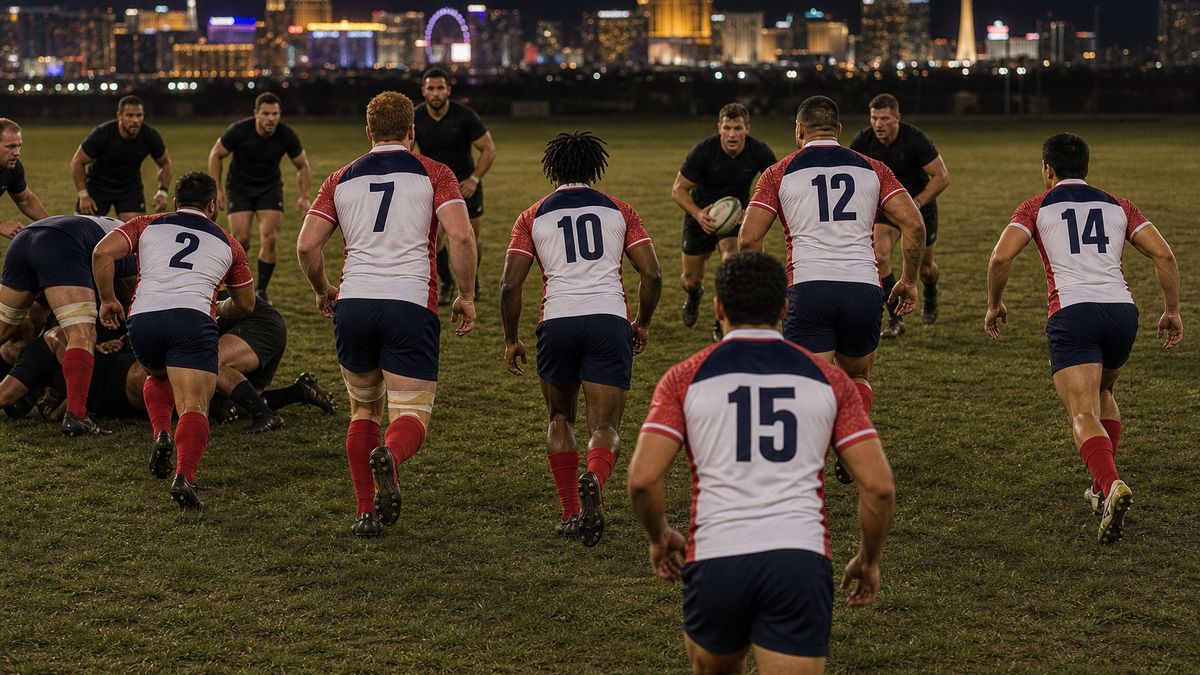
Key facts at a glance
- Players: no more than 10 per team on the field during play (World Rugby 10s variations, Law 3)
- Scrum: five players per side, two props, a hooker and two locks, who must stay bound until it ends (10s variations, Law 19)
- Restarts: after a score, the scoring team kicks off with a drop kick from the halfway line (10s variations, Law 12)
- Yellow card: two minutes in the 10s variations, so short-handed defense is a skill you will need
- Tackle height: community rugby moved to a lower tackle height (base of sternum or waist) for seasons starting after 1 July 2026
- APR Games 2027: 10-a-side, two 20-minute halves, May 29–31, 2027, Las Vegas; full rules confirmed with player registration
Four guides in, the Knights' defensive playbook is taking shape: rugby defense systems (how the line moves), how to tackle in rugby safely, rugby fitness for defenders and breakdown defense: the jackal and the counter-ruck. All of them were written mostly with fifteen-a-side rugby in mind. This one is about the format we will actually play at the APR Games 2027: tens.
If tens is new to you, start with the Vegas Kings' guide, rugby tens explained: the 10-a-side format of the APR Games, which covers the laws and history. Here we look at it from the defender's side: what changes when you take five players off a full-size pitch, how to set a defensive shape, and why communication decides more tens games than collisions do. This is general information drawn from World Rugby's laws and established coaching resources, not a substitute for a qualified coach.
How is defending in tens different from fifteens and sevens?
Tens sits between the two formats most players know. Rugby tens was introduced by the Combined Old Boys Rugby Association (COBRA) in Malaysia in 1967 and is usually played by five forwards and five backs. Under World Rugby's 10s law variations, each team has no more than ten players on the field, the scrum has five players per side, a match is 20 minutes plus time lost (two halves of not more than 10 minutes each), and match organizers may vary the duration. The APR Games uses longer, two 20-minute halves.
For a defender, the key point is space. The pitch is the same size as in fifteens, but there are a third fewer bodies to fill it. Every missed tackle or late fold leaves a bigger hole, and there are fewer teammates behind you to fix it. At the same time, there are more players than in sevens, so a tens defense can be more physical at the contact area and can afford a full defensive line plus cover.
| Fifteens | Tens | Sevens | |
|---|---|---|---|
| Players on the field | 15 | 10 | 7 |
| Players in the scrum | 8 | 5 (2 props, hooker, 2 locks) | 3 |
| Standard match length (World Rugby) | 80 minutes | 20 minutes, two halves of up to 10 (organizers may vary; APR Games: two 20-minute halves) | Two 7-minute halves |
| Who kicks off after a score | The team that conceded | The team that scored | The team that scored |
| Yellow card | 10 minutes | 2 minutes | 2 minutes |
| Typical defensive shape | Full line plus back three covering kicks | 8–9 in the line, 1–2 sweepers | 6 in the line plus 1 sweeper |
| Biggest defensive risk | Fatigue and numbers at the breakdown | Space between defenders and lost breakdown contests | One missed tackle often means a try |
Based on World Rugby's Laws of the Game and its 7s and 10s variations, and Rugby Tens' January 2026 law variations (accessed November 2026). Competition organizers can vary match length, replacements and other details; APR Games rules will be confirmed with player registration.
What defensive shape works with ten players?
There is no single "correct" tens defense, but most systems borrow from sevens, where the problem of defending a wide pitch with few players has been studied for decades. New Zealand Rugby's Rugby Toolbox describes the basic sevens pattern as "a defender in each of 6 lanes and a sweeper behind" or "a defence line of 5 and 2 sweepers". Coach Ross Snook, writing for the same resource, describes a system "operated from inside-out" with "mainly six defenders in the front line and a sweeper in behind".
Scale that up to ten players and the common tens shapes look like this:
- Nine up, one back. Nine defenders in the front line, each owning a lane, and one sweeper (often the fullback) ten to fifteen meters behind. This gives the strongest line and still covers the short kick. It is the most common starting shape.
- Eight up, two back. Two sweepers, one on each side of the field, for teams that face a lot of kicking or have a slower line. The trade-off is an attacking overload in front.
- Ruck guards plus the line. At a breakdown, one or two defenders guard each side of the ruck (often forwards), and the rest of the line spreads out from them in lanes. If a forward is caught on the ground, a back fills the guard spot and the shape shifts across.
Whatever the numbers, the rules of the shape stay the same. Rugby Toolbox puts it simply: "Defend inside out. Don't chase the ball." Each defender owns the attacker in their lane, the inside shoulder of that attacker in particular, and trusts the teammate inside them. A defender who drifts off their lane to chase the ball carrier leaves a gap behind them, and in tens that gap is usually wide enough for a try.
The sweeper: last line and loudest voice
The sweeper is the tens defense's insurance policy. According to Snook, the sweeper is "positioned to take short chip kicks" and runs back to field the long kick and chase. Rugby Toolbox advises coaches to "pick your fastest, most skilful players" for the role. In tens the sweeper has one more job: they can see the whole attack, so they tell the line what is coming, such as an overlap out wide, a runner on a switch line or an attacker hanging back for a kick.
Shape beats size in tens. A connected line of ten average tacklers will stop more tries than ten big hitters who each defend their own way. The shield is only as strong as the gaps between the plates, so own your lane, trust your inside man and keep the line flat.
Should a tens defense rush or drift?
The same two families of defense from our defense systems guide apply in tens, with some tweaks for space.
Line speed and rush. Rugby Toolbox's second defensive principle is to "go forward to a pattern to reduce time and space to prevent the attack getting over the gain line". A fast line takes away decision time, and in tens many teams' handling is not as sharp as in sevens, so pressure creates errors. But the warning from sevens applies: "A rush defence only works if everyone goes." One player who hangs back, or one who rushes alone, creates the hole the attack is looking for. In sevens, Rugby Toolbox notes, "you need at least 6 in the line otherwise the attack will have an overlap". In tens, that means a rush with a full line, not a rush with players still getting up from the last ruck.
Drift. When the attack has numbers out wide or the defense is short, the line slides across together, defending inside-out and pushing the attack toward the touchline, where the touchline acts as an extra defender. Snook's drill for this is "3 v 3 in a 20m grid with the defence holding their shape and forcing the last attacker over the sideline." The risk with drift in tens is the inside pass, so the defender on the ball must stay square long enough to stop the carrier cutting back.
Mixing the two. Most good tens defenses start with line speed in the middle of the field, close to the ruck, and drift on the edges. The inside defenders squeeze, the outside defenders slow the attack down, and the sweeper covers the kick over the top. Former Welsh Sevens coach Colin Hillman, interviewed by Dan Cottrell for Rugby Coach Weekly, gave a simple rule for the middle: "don't get broken through in the middle."
What should defenders say? Communication in tens
Ask any coach what goes wrong in a tens defense and the answer is usually the same: silence. With fewer players and more space, defenders cannot rely on seeing everything. They have to hear it. Hillman's line to his players is worth putting on the changing-room wall: "if you are standing in defence you are not working." Working means moving, and it means talking.
Good defensive communication in tens is short, loud and specific. The exact words vary from team to team, but most systems cover the same jobs:
- Numbers and ownership: "I've got 10", "I'm on the hooker", "two out". Every defender names the attacker they own. If two defenders name the same attacker, someone else is unmarked.
- Line speed: one leader, often the defender beside the ruck, calls "up" or "go" so everyone leaves together, and "hold" or "slide" when it is time to drift.
- Inside and outside help: "inside" means "I've got your inside, push out"; "outside" means "cover the man outside you". The defender on the ball listens to the player inside them.
- The breakdown call: "ball" or "jackal" when one player is competing, "fold" or "out" when everyone else should get back into the line. Our breakdown defense guide covers when each is right.
- Sweeper talk: "kick", "short", "overlap left", "switch". The sweeper is the only defender facing the whole attack.
- Short-handed calls: "nine", "we're one down", so the line spreads out and the sweeper steps up during a two-minute yellow card or when a player is still on the ground.
Hillman also described a three-player unit rule: "The player who is defending the ball does not move up unless he has a man either side of him." It is a useful tens habit. Before the line goes, each defender checks left and right. If the inside or outside player is missing, they call it and hold for a split second until the gap is filled.

Unity is the fourth value in the Knights Code for a reason. In tens, unity is something you can hear. If the sideline cannot hear our defense calling from the stands, we are not talking enough. Quiet defenses get split; loud defenses get turnovers.
How do you tackle in space?
Tens creates more one-on-one tackles in open space than fifteens does, and a missed one is far more costly. The fundamentals from our safe tackling guide still apply: close the space, get low, head to the side, wrap the arms and drive with the legs. A few points matter more in tens:
- Close the space, then slow down. Sprint to cut the attacker's time, then take short steps as you get close so you can react to a step. Overrunning a fast attacker is the most common open-field miss.
- Use the touchline. Approach from the inside so the attacker's only way out is toward the sideline. Rugby Toolbox's sevens guidance is to "tackle from the side, inside out or outside in", not head-on where possible.
- Get your foot close. Snook describes the ideal: the tackler gets their foot in as close to the ball carrier as possible "so that in one action he can smother the man and the ball."
- Finish the tackle yourself. Rugby Toolbox's advice is to "complete every tackle yourself". In tens, the second defender may be ten meters away.
- Stay low and legal. World Rugby approved a lower community tackle height into full law on 17 June 2026, for seasons starting after 1 July 2026, with competitions choosing the base of the sternum or the waist. From 1 November 2026 the hip-drop tackle was added to the dangerous play law (Law 9.13). Check the tackle height used in your competition.
Safety note: tackling at speed in open space is one of the highest-risk moments in rugby. World Rugby's Tackle Ready program (launched September 2021) said that 76% of head injuries happen in the tackle and two-thirds of those are to the tackler. Learn and progress tackling under a qualified coach, start with walking-pace technique work and pads, match players by size and experience, and if anyone shows signs of a possible concussion, recognise and remove them and follow your union's concussion protocol. This article is not medical advice.

When should a tens defense compete at the breakdown?
With ten defenders, every player committed to a ruck is ten per cent of the defense. Commit two to a contest you lose and the attack is playing against eight, on a full-size pitch. That is why many tens teams compete selectively.
World Rugby's Breakdown Ready defensive cues offer a clear rule of thumb. If the tackle is dominant (the carrier is going backwards), the tackler gets up and competes or counter-rucks, and support players may jackal or counter-ruck. If the tackle is passive, the tackler rolls away immediately and gets back into the line, and the rest of the defense fills the gaps. In tens, that second option is usually the right one. The prize for a good decision is big: Snook calls turnover ball "a real killer in sevens", and the same is true in tens, because a turnover arrives with space everywhere and an attack that is out of shape.
The Vegas Blackjacks' guide, rugby rucking explained, shows what the attack is trying to do at the ruck. Knowing their cleaners' jobs helps you decide when a contest is worth it.
How do you defend tens set pieces and restarts?
Scrums
Under the 10s variations, each scrum has five players per side who "must stay bound to the scrum until it ends and may not unbind to play the ball". There is no number 8 and no flankers to break off. So at a scrum, the five defending backs face the five attacking backs with no extra cover from the pack. Good tens defenses line up evenly, one defender per attacker, with the scrum-half working close to the scrum and the sweeper ready to step into the line if needed. If your forwards are new to the five-player scrum, the Blackjacks' scrum technique guide covers the front-row basics, and all scrummaging should be coached by qualified staff.
Restarts after a score
In tens the team that scores kicks off, with a drop kick from on or behind the center of the halfway line, and the ball must reach the 10-meter line. That changes defense in two ways. First, after you score you immediately become the defending team, chasing your own kick, so the kick chase is a defensive drill, not an afterthought. Second, after you concede you receive the ball, which is a chance to reset. A kick chase in tens works like a mini line: chasers run in a connected shape, the fastest chaser goes for the catcher, and one player stays back as a sweeper in case the receivers kick long.
Defending a man down
A yellow card in the 10s variations lasts two minutes. Two minutes with nine players feels long on a full pitch, so practice it. The usual fix is to pull the sweeper into the line, defend narrower in the middle, and accept that the outside attacker may get the ball, then use the touchline and line speed from the outside to close them down.
Honor in tens looks like discipline. Every penalty is a quick-tap chance against a defense that is not set, and a yellow card is two minutes on a big pitch with nine. Stay on your feet, stay onside and keep your hands out of the ruck. The cheapest defense is the one that never gives the ball back.
How fit do you need to be to defend in tens?
Defending in tens means repeated sprints to reset the line, then a tackle, then another reset. The repeated high-intensity effort pattern we covered in rugby fitness for defenders applies, with more running between contacts. With two 20-minute halves at the APR Games, matches are longer than the standard tens format, so players should prepare like they are playing a short fifteens game, not a sevens match. The Vegas Kings' 6-week pre-season conditioning plan is a good place to start, and the Vegas Lions' guide to rugby speed training and the first 10 meters will help with line speed.
Replacements also matter. World Rugby's 10s variations allow a team to nominate up to five replacements and say match organizers may vary that number; the APR Games' exact replacement rules will be confirmed with player registration. Either way, a defense that rotates fresh legs into the wide channels keeps its line speed late in the half.
Tens defense drills (a safe progression)
These drills build shape and talk first, then add contact. Run them under a qualified coach, keep early sessions at touch or shield level, and only add live tackling when technique is solid.
1. Lanes walk-through
Ten defenders, ten cones on a line across the field, ten attackers walking. On "up", the line moves together, each defender naming the attacker they own. The coach freezes play and checks for gaps, doubled-up attackers and players chasing the ball.
2. Hillman's overload
Hillman's drill: "match 3 defenders against 5 attackers" on "half the width of the pitch" for "2 minutes". Defenders must talk, drift and use the touchline to survive. Use touch first, then two-handed grab.
3. Snook's 3 v 3 grid
Three defenders against three attackers in a 20-meter grid. The defense holds its shape and forces the last attacker over the sideline. Great for inside-out habits and tackling from the side.
4. Ruck, fold and go
A coach rolls a ball to the ground and calls "dominant" or "passive". On "dominant", one player competes and calls "ball"; on "passive", everyone folds, re-forms the line and moves up on the leader's call. Count how long it takes to get all ten defenders set.
5. Kick-off chase with nine
Practice restarts with one player off: the team kicks off, chases in shape with nine, and defends three phases. It builds both the kick chase and the yellow-card shape in one drill.
Defending the shield at the APR Games 2027
The APR Games 2027 is 10-a-side rugby with two 20-minute halves and evening kickoffs on three fields, Memorial Day weekend, May 29–31, 2027, in Las Vegas. The Vegas Knights are one of five founding franchises, alongside the Vegas Kings, the Vegas Blackjacks, Downtown Rugby and the Vegas Lions, plus one invitational team still to be revealed. Meet them all on the APR teams page. Full rules and squad sizes will be confirmed with player registration.
Coaches can look out for the APR coaching clinic, May 28–31, 2027, in Las Vegas, and APR's Tuesday Skills series on americanprorugby.com. For the latest law news and world rugby headlines, see APR's global rugby news. New to the game? Downtown Rugby's rugby rules for beginners covers the laws you need first.
Ten players. One shield. Join the waitlist.
The APR Games 2027: Men's Elite ($10,000 prize pool), Women's Social ($5,000) and Youth divisions. Player entry is $299 and includes a team jersey, a full kit bag, at least three pool games and opening-night access.
Join the APR Games waitlistBuilding a tens team in Las Vegas
Tens is a great format for clubs and workplaces putting a squad together, because you need fewer players than fifteens but still get real rugby, with scrums, lineouts and contested rucks. If you are a local business thinking about backing a team, APR partner In Too Win works in Las Vegas business and investment, and American LED Signage covers signage for venues and businesses, the kind that lights up a clubhouse or a sideline on a tournament night. For one rugby skill and one strength block every week, join APR's free newsletter, The Breakdown, and pick up team gear on the APR merch store.
Why tens is a defender's format
It is easy to think of tens as an attacking game: more space, more breaks, more tries. But the teams that go deep in tens tournaments are usually the ones that defend as a unit. They keep their shape, they talk without stopping, they tackle in space and they pick their breakdown battles. That is the Knights Code in action: Honor in discipline, Valor in the one-on-one tackle, Unity in the calls and Victory in the turnovers that follow. Ten players, one shield.
Frequently asked questions
How many players are on a tens rugby team?
Each team has no more than ten players on the field during play, usually five forwards and five backs. World Rugby's 10s variations allow up to five replacements, and match organizers may vary that number.
What is the best defensive shape in tens rugby?
Most teams start with nine defenders in the front line and one sweeper behind, or eight and two sweepers against a kicking team. The key is defending inside-out, owning your lane and moving up together.
What does a sweeper do in tens rugby?
The sweeper stands behind the defensive line to cover short chip kicks and long kicks, acts as the last line of defense and calls what the attack is doing, such as overlaps, switches and kicks.
Should a tens defense blitz or drift?
Usually both. Many teams use line speed close to the ruck to pressure the attack and drift on the edges, pushing the attack toward the touchline. A rush only works if the whole line goes together.
How many players are in a tens scrum?
Five per side: two props, a hooker and two locks. Under the 10s variations they must stay bound until the scrum ends and may not unbind to play the ball.
Who kicks off after a try in tens rugby?
In tens, the team that scored kicks off with a drop kick from the halfway line, and the ball must reach the 10-meter line. That means the scoring team must chase and defend straight away.
How long is a yellow card in tens rugby?
Two minutes under World Rugby's 10s variations. Teams should practice defending with nine players by pulling the sweeper into the line and defending narrower.
Should you compete at every breakdown in tens?
No. With only ten defenders, committing players to a lost contest leaves big gaps. Compete when the tackle is clearly dominant and fold back into the line when it is not.
What do defenders shout in rugby?
Common calls name the attacker you own, signal when the line moves up or drifts, ask for inside or outside help, and say whether a player is competing for the ball or everyone should fold. Each team agrees its own words.
How long are APR Games matches?
The APR Games 2027 in Las Vegas, May 29–31, 2027, is 10-a-side rugby with two 20-minute halves and evening kickoffs. Full rules and squad sizes will be confirmed with player registration.
Keep reading
Sources
- World Rugby Laws of the Game: 7s, 10s, U19 and Game On variations (accessed November 2026)
- World Rugby, 10s variations: Law 3 Team (accessed November 2026)
- World Rugby, 10s variations: Law 5 Time (accessed November 2026)
- World Rugby, 10s variations: Law 12 Kick-off and restart kicks (accessed November 2026)
- World Rugby, 10s variations: Law 19 Scrum (accessed November 2026)
- Rugby Tens: laws and variations (January 2026)
- Rugby tens (Wikipedia, accessed November 2026)
- New Zealand Rugby, Rugby Toolbox: Sevens principles of defence (accessed November 2026)
- Rugby Toolbox: Defence principle two, go forward (accessed November 2026)
- Rugby Toolbox, Snook on Coaching: Sevens defence (accessed November 2026)
- Rugby Coach Weekly (Dan Cottrell): Set up your rugby sevens defence (accessed November 2026)
- World Rugby Breakdown Ready: Defensive cues (accessed November 2026)
- World Rugby: Community tackle height law wordings approved, June 2026
- World Rugby: World Rugby clarifies law on dangerous tackles, 7 October 2026
- American Pro Rugby: APR Games 2027
This guide is general information, not individual coaching or medical advice. Tackling, scrummaging and other contact skills should be learned and progressed under a qualified coach, and players should get clearance from a qualified professional after injury or illness. Laws, law variations and tackle-height rules vary by competition and organizers may change match length and replacements; check your competition's current laws. APR Games rules and squad sizes will be confirmed with player registration. Written November 2026.